
• Tech Book of the Month
  • Archive
  • Recommend a Book
  • Choose The Next Book
  • Sign Up
  • About
  • Search
Tech Book of the Month
  • Tech Book of the Month
  • Archive
  • Recommend a Book
  • Choose The Next Book
  • Sign Up
  • About
  • Search

November 2023 - Co-Opetition by Adam Brandenburger and Barry J. Nalebuff

This month we jump back to an older strategy book to think about pricing, partnerships, and negotiations.

Tech Themes

  1. Pricing Printers Poorly. The late-80’s printer aisle looked like trench warfare. There were three types of desktop printers: Dot-matrix (low-end), ink-jets (mid-tier), and laser printers (high-end). The laser segment had the highest prices, best margins, and was growing the fastest. Epson, normally a dot-matrix manufacturer, decided it should enter the laser segment with a competitively priced product, the EPL-6000. One week later, Hewlett‑Packard came out with a printer priced signficantly below Epson’s EPL-6000. Epson further cut price in response. Although Epson gained market share, the damage was done: hardware profits collapsed, and suppliers shifted to a razor-and-blades model, where ink or toner carried gross margins of 60 % or more. But because pricing had come down across the low-end, mid-tier, and high-end, ink-jets started to overtake dot-matrix sales - a better printer for a similar price to a dot-matrix a few months ago. Epson had completely screwed over the segment it was most dominant in by introducing a new, effective competitor. “What was Epson’s mistake? It misunderstood the Scope of the printer game. By treating the laser printer game as separate from the dot-matrix printer game, Epson failed to see that low-price entry into the laser segment could jeopardize its core business.” Epson eventually discovered the peril of winning the wrong battle.

  2. Bidding. In 1984, the FCC divided the country up into 306 separate markets and gave two cellular licenses to each market. Craig McCaw wanted a national cellular footprint before anyone else and went around buying up as many licenses as he could. Lin Broadcasting owned plum metro licenses—Los Angeles, Dallas, New York—that would knit perfectly into McCaw’s West‑Coast empire. In 1989, he made a hostile bid for LIN, conditional on LIN removing the poison pill anti-takeover clause in its shareholder rights plan. Poison Pill’s generally allow companies to issue extreme amounts of shares to dilute a potential acquirer’s interest, thereby making it uneconomic to buy shares in the company. BellSouth, already Lin’s roaming partner, had already crashed the party with a “white‑knight” merger plan and a special $40 dividend, arguing that its investment‑grade balance sheet trumped McCaw’s bidding frenzy. The challenge for BellSouth, was that McCaw had more aggresssive future assumptions for the value of Points of Presence (POPs, or consumers), and thus could justify a much higher bid than BellSouth. BellSouth saw an opportunity to “engage” in the bidding process, but only if LIN agreed to give it a $54m fee and cover $15m of BellSouth’s expenses. When McCaw raised his bid, LIN increased BellSouth’s expense cap to $25m. McCaw, wanting to move quickly to get LIN’s assets and aware of BellSouth’s lack of real interest in acquiring the company, quietly paid BellSouth $26m to stop bidding. McCaw then increased his bid to $6.3B (up from $5.85B) and won the deal. The takeaway here is that BellSouth understood there was some easy money to be gained by entering the bidding process. If it won at a fair price, it would be happy, if not, it would get $75m cash for doing a small amount of work. McCaw also understood that there weren’t any real rules governing BellSouth’s bid and that any payment between parties would be governed by contract law, avoiding any potential antitrust issues. A similar dance played out on Texas’ coast. Corpus Christi’s ABC, NBC, and CBS affiliates—founded decades earlier by local entrepreneurs who treated broadcasting like a civic duty—banded together in 1993 to demand per‑subscriber fees from cable giant TCI. John Malone, ever the game theorist, yanked their signals, flooded the market with distant‑signal substitutes, and quietly negotiated bundled carriage rights in nearby Beaumont before the stations blinked. When one of the entrepreneurs who owned a Beaumont station offered its signal for free, TCI refused. Here, TCI was linking the Beaumont decision to the Corpus Christi decision. By not carrying Beaumont, he was signaling that “how you play me in one city will impact how I do business with you in another.” The DOJ later sued the three broadcasters for collusion, but Malone still walked away having proven that controlling the pipe gives you leverage even when you’re shut out of content. In 2023, when carriage talks collapsed, Charter yanked ESPN and 17 other Disney channels from 14 million Spectrum homes, betting that broadband stickiness outweighed sports FOMO. Disney finally folded, granting free ad‑tier Disney+ access to Spectrum subs—a Malone‑esque outcome.

  3. Cheap Complements and Cheap Competition. When Electronic Arts founder Trip Hawkins launched the 3DO Interactive Multiplayer in 1993, he flipped the console model on its head: keep license fees tiny so developers flood the platform, outsource hardware to Panasonic and GoldStar, and collect a royalty on every game sold. Developers indeed piled in—over 300 titles were announced within 18 months—but the box debuted at a prohibitive $699, three times a Super NES. Consumers passed, inventories ballooned, and retailers slashed shelf space, proving that abundant complements can’t rescue a core product priced for plutocrats. Worse, the royalty stream never matured: with a sub‑million installed base, even best‑selling games shipped under 50k units. By 1996, Hawkins shuttered 3DO hardware, pivoted to software, and lost the ecosystem he had courted. Co‑opetition’s moral: complements add value only when they multiply an affordable core, not when they subsidize an unaffordable one. Apple’s $3,499 Vision Pro dazzles developers yet risks 3DO déjà vu: a high‑end box in search of an installed base big enough to justify killer apps. It seems like there isn’t actually a market there after all. Big Tech’s co‑opetition looks like a rotating tag‑team match: Apple and Google split roughly $20 billion a year in Safari search‑rent—cash Apple pockets while Google keeps iPhone eyeballs—yet the same pact boxes Microsoft’s Bing out of mobile search entirely. Microsoft struck back in 2023 by wiring OpenAI’s GPT‑4 into Bing Chat, forcing Google to scramble with Bard (now Gemini); each new model is less about revenue today than denying the other a toehold in AI mindshare. And sometimes a “friendly” move for one is a gut punch for another: Apple’s App‑Tracking‑Transparency switch won plaudits for privacy but wiped an estimated $12 billion off Meta’s 2022 ad revenue, reminding every platform that a partner today can set the rules tomorrow.

Business Themes

The-Capital-Cycle.jpg
  1. PARTS. Players, Added Value, Rules, Tactics, Scope. Players - List every party that can affect the game—not just obvious competitors but suppliers, complementors, customers, regulators, and would‑be entrants. Brandenburger and Nalebuff call this the “value net.” Miss a player and you misprice your leverage: Epson forgot ink suppliers; Trip Hawkins forgot retailers. Added  Value - Quantify how much value the game loses if you step out. Holland Sweetener added so little that NutraSweet could cut price to drive it out. Your bargaining power equals your added value, nothing more. Rules - These are the formal and informal contracts that shape payoffs—patents, standards, MFN clauses, or even industry norms. Changing a single rule (e.g., allowing distant‑signal import in Corpus Christi) can flip winners and losers overnight. Tactics - Moves and countermoves that alter perceptions or hide true intentions: McCaw’s escalating bids signaled resolve; BellSouth’s dividend sweetener signaled financial strength. In judo strategy, feints and timing matter as much as raw force. Scope - Decide which arenas the game covers—geography, product lines, time horizon. Sega narrowed scope to teens; Ryanair to short‑haul cheap UK-Ireland flights. Expanding or shrinking scope can turn a losing game into a winning one.

  2. Added Value Reduction. Added value equals “pie with you” minus “pie without you.” Holland Sweetener stormed NutraSweet’s European aspartame stronghold in 1987, hoping to undercut Monsanto’s $70‑per‑pound monopoly. NutraSweet responded by chopping price to $22 and locking Coke and Pepsi into long‑term supply deals. Consumers enjoyed lower prices, but Holland’s new plant hemorrhaged cash and eventually shut down. The pie grew, yet Holland’s slice was negative—a textbook case of creating consumer surplus you can’t capture. IBM managed the opposite trick. Its open‑architecture PC spawned an army of Compaq‑ and Dell‑clones that used reverse‑engineered BIOS chips to deliver 95 % of the function at 60 % of the price. IBM had given up its added value by going both open and outsourcing the manufacturing of the computers, leaving very little IP or value add (outside of brand) to be monetized. By 1990 IBM’s own share of the “IBM‑compatible” market had cratered, and the company ultimately exited retail PCs, conceding de facto standards to the very cloners it had empowered. When your absence barely dents the ecosystem, your added value rounds to zero. OpenAI’s proprietary GPT models generate a lot of value, but Meta’s open-source Llama models enable startups to create custom copilots at near-zero licensing costs, potentially eroding GPT’s pricing umbrella much as Holland Sweetener eroded NutraSweet. Right now, Llama models are just not even close to as good as OpenAI’s models, so up to this point there has been no price erosion. However, price erosion may be the ultimate goal of Mark Zuckerberg, create an open, cheap, cost-competitive model that becomes a no brainer standard and hurts OpenAI’s position with proprietary models. Zuck knows that chatGPT is taking away device time from Instagram and see it as a long-term threat. The pie grows; who keeps the surplus is still up for grabs.

  3. Playing Judo. Sega entered 1990 with 6 % U.S. console share; Nintendo held 94 %. Instead of matching Nintendo’s kids‑friendly catalog, Sega leaned into a teen demographic with Sonic the Hedgehog, faster 16‑bit hardware, and cheeky ads (“Genesis does what Nintendon’t”). Nintendo rushed the Super NES and loosened violence taboos, but by 1994 share was near‑parity. Eventually Nintendo’s stronger software pipeline reclaimed leadership, Sega exited hardware in 2001, and the market stabilized with clearly segmented audiences—a judo bout where the lighter fighter scored enough points before the heavyweight regained footing. Europe’s skies offer another judo masterclass. Ryanair slashed Dublin‑London fares from $150 to under $100 in 1991, betting that a no‑frills model, 30‑minute turnarounds, and a single 737 fleet would lure new flyers instead of stealing British Airways’ elite road‑warriors. BA could have matched fares system‑wide and bled billions; instead, it ceded price‑sensitive segments while defending long‑haul premium cabins. Today, Ryanair ferries more passengers than any other European airline, yet BA still dominates trans‑Atlantic business class. Sometimes, yielding the mat where you’re weakest is how you keep the championship belt.

    Dig Deeper
  • The Making of Electronic Arts & 3DO - Trip Hawkins Interview

  • Computer History - The History of IBM and the Clone Wars

  • Michael O'Leary: Ryanair's Maverick CEO

  • The Billion-Dollar Battle Between Red Bull and Monster

  • What is a Most Favored Nation Clause? | Contract Central

tags: Adam Brandenburger, Barry Nalebuff, Epson, HP, Hewlett-Packard, Craig McCaw, LIN, BellSouth, TCI, John Malone, Charter, Trip Hawkins, 3DO Interactive, EA, Apple, Google, OpenAI, Microsoft, Meta, NutraSweet, Monsanto, IBM, Compaq, SEGA, Nintendo, Ryanair, Mark Zuckerberg, British Airways
categories: Non-Fiction
 

October 2023 - The Outsiders by Will Thorndike

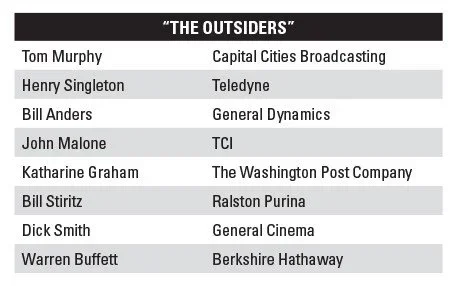
This month we read an absolute classic on capital allocation. Nothing says Outsider like multiple family businesses and white male HBS graduate CEOs! To be fair, many were “outsiders” to their industry. Either way, its a short and compelling read. Thorndike makes the point early in the book that this group of companies has outperformed the S&P over a prolonged period - but as an LP once said: “I’ve never seen a bad backtest.” I don’t view any of the practices in this book as rigid. These are not hammers to a nail, these are options for any executive considering the best use of cash.

Tech Themes

  1. No straight lines. As is the case with many a business book, success is often portrayed as linear, despite being filled with the ups and downs that are natural in life. For example, when a young Tom Murphy took over a struggling radio station in Albany, he had to tightly manage the company through YEARS of operating losses, before he could turn on the offensive and start acquiring small competitors and buying back stock. Eventually, the cash generated from his businesses allowed him to acquire ABC for $3.5B in 1986, in a large extremely successful acquisition. Other Outsider CEOs also experienced challenges. Dick Smith’s General Cinema spin-off GCC went bankrupt in the late 1990s, as the cinema business became more competitive. Despite being an incredible CEO and capital allocator, Smith failed to save the initial company that generated the cash to build his business. When Bill Anders walked through the front door on his first day at General Dynamics, the company was bleeding cash, had a $600m mountain of debt, and a market cap of $1B despite $10B in annual revenues. Katharine Graham was thrust into the role of CEO at the Washington Post after her husband Philip Graham passed away. She was a mother of four, with little operating experience, stepping into the CEO role at a Fortune 500 company. Even the best CEOs experience the intensity of failing businesses, learning to push through the noise and emerge on the other side in tact can create the skill and resilience needed to thrive.

  2. Improving Operations. Every CEO mentioned in the book was obsessive about improving operations and watching costs. Teledyne took a unique approach to driving operational discipline - they decentralized the organization. Driven by the need to diversify out of core businesses due to very restrictive M&A laws, the companies of the conglomerate era often acquired extremely diverse business interests and centralized operations to yield “synergies.” Teledyne took the opposite approach. Rather than rolling everything into one big corporate headquarters, they kept HQ lean, and pushed accountability and responsibility deep into their industrial subsidiaries. The result, managers that ran their organizations like owners, something Mark Leonard would be proud of. Bill Stiritz at Ralston Purina took a very aggressive approach to operational discipline. As Thorndike puts it: “Businesses that could not generate acceptable returns were sold (or closed). These divestitures included underperforming food brands (including the Van de Kamp’s frozen seafood division, a rare acquisition mistake) and the company’s legacy agricultural feed business.” Not only was Stiritz a hawk, carefully curating and watching his best business units, but he also was willing to let go of past mistakes to improve the core. This mental flexibility, and being able to not tie himself to an acquisition showed his extreme discipline in how he ran Ralston Purina. For a long time, the venture capital industry has provided substantial sums of cash to successful startups at ever climbing valuations, but these waves of cash can erode operational discipline that make CEOs great. We’ve seen a few companies (like Meta) embrace a new wave of efficiency

  3. Winner Takes Most. Tom Murphy and Dan Burke were the perfect capital allocator (Tom) and disciplined operating executive (Dan) pair. They also knew Capital Cities business inside and out, to a point where they could truly understand the market, in a way only a competent insider with large swaths of information could. Thorndike writes: “Murphy and Burke realized that the key drivers of profitability in most of their businesses were revenue growth and advertising market share. For example, Murphy and Burke realized early on that the TV station that was number one in local news ended up with a disproportionate share of the market’s advertising revenue. As a result, Capital Cities stations always invested heavily in news talent and technology.” This idea around disproportionate share can also be called “Winner takes most,” and most software markets exhibit this dynamic. There are several reasons for this including Economies of Scale, Standardization, and Perceived Safety. Let’s take Atlassian’s Jira and Confluence through this lens. Because Atlassian is the largest provider of Product Management and Wiki software, it can spread its R&D costs across a very large number of users. The larger it gets, the lower per user cost it maintains. With the low distribution costs that software has, Atlassian can continually price its software extremely competitively to a point where its the best value (price to value received by customer) on the market. Software markets also tend to standardize on formats: think VHS vs. Betamax, HD DVD vs. Blue Ray, Apple vs. Microsoft/Intel. If the market is massive, there can be multiple winners (like Apple vs. Android or the three cloud providers). But once you become a standard in a medium to large sized market, it can be very difficult to flip that standard, because it takes re-jiggering the entire value chain. For example, a new product management software would mean software engineers, product/engineering managers, designers, and executives would need to all flip to a new standard. Its the reason Autodesk maintains a large market share, 40 years after the founding of AutoCAD. And this bring us to our last point, Perceived Safety. Brands are based on perceptions. Standards create the perception of safety - that they will exist in 10 years, that the executive choosing the standard won’t be fired for that choice, that the software will work at scale. Everyone hates on Jira, just like they hate on AutoCAD, or Salesforce, or Oracle. But these companies have all become standards, and individuals perceive standards as safe. Winner takes most markets are all about building that strong combination of price and value.

Business Themes

Outsiders_CEOs.webp
  1. Buybacks, Acquisitions, Divestitures. One common trait from the outsider CEOs is not being shy when the market presents an incredible deal. Thorndike attempts to portray this as executives walking through simple math to come to straight forward conclusions. However, I believe this comes down to knowing exactly what you want. Tom Murphy, for example, kept a list of A+ assets he’d like to acquire (at a reasonable price) and waited until the time came, which is reminiscent of Chris Hohn’s approach too. Not that they couldn’t be flexible in approaching a new deal, but more that they had a very strong inkling of what and how financial returns could work and knew the competitive positioning of the assets they were purchasing deeply. Henry Singleton knew no business better than his own, and he flexed that muscle whenever the market gave him an opportunity to do so. As Thorndike says: “Henry Singleton is the Babe Ruth of repurchases… between 1972 and 1984, in eight separate tender offers, he bought back an astonishing 90% of Teledyne’s outstanding shares.” And Henry was not afraid of size nor leverage. “In May of 1980, with Teledyne’s P/E multiple near an all time low, Singleton initiated the comapny’s largest tender yet, which was oversubscribed by threefold. Singleton decided to buy all the tendered shares (over 20% of shares outstanding), and given the company’s strong free cash flow and a recent drop in interest rates, financed the entire repurchase with fixed rate debt.” We must be clear that buybacks are not always the right move and include many frictional costs that mean that not all shareholder dollars are being spent directly on share repurchases. Bill Stiritz of Ralston Purina was also not afraid to buy in size: “When the opportunity to buy Energizer came up, a small group of us met at 1:00pm and got the seller’s books. We performed a back of the envelope LBO model, met again at 4:00pm and decided to bid $1.4B”. Ralston would later spin Energizer Holdings out in 2000 for ~$2.1B, after selling off some smaller pieces of the business. About 20 months later, Ralston sold itself to Nestle for $10.3B. Stirtiz then began another consumer brands conglomerate with Post Holdings. Here, Stiritz was a buyer at one price, a seller at another, and a seller of his whole business at a huge take out price. At General Dynamics, Bill Anders refocused the company on areas where it could maintain a dominant market position. For example, General Dynamics owned the much lauded F-16 fighter plane division, but it was much smaller than industry counterpart Lockheed Martin. When Lockheed’s CEO offered him $1.5B for the division, an extremely high price (at the time), Anders sold it on the spot. Thorndike notes: “Anders made the rational business decision, the one that was consistent with growing per share value, even though it shrank his company to less than half its former size and robbed him of his favorite perk as CEO: the opportunity to fly the company’s cutting edge jets.” Looking back, the F16 went on to be a staple fighter plane in many militaries around the world, with individual contracts totaling well above $10B. I wonder if Anders still believes this was the best course of action for the company. It certainly saved it in the short term, but GD missed out on years of revenue from the F-16. Either way, Anders, along with other outsider CEOs weren’t afraid to shrink the company or grow the company via acquisitions, buybacks, and divestitures. Talk about the big acquisitions, big buybacks, big divestitures. Ralston-Energizer, Teledyne buying back a ton, Dick Smith buys and sales and spins.

  2. Best Ideas Win. The outsider CEOs were totally willing to let others influence their decision making. Dick Smith created an Office of the Chairman, consisting of Chief Final Officer Woody Ives, Chief Operating Officer Bob Tarr, and corporate counsel Sam Frankenheim. As Thorndike writes: “Woody Ives, the company’s talented CFO, remembers one of his proudest moments at General Cinema (Ives later left to lead a successful turnaround at Eastern Resources), when a joint venture to enter the cable business with Comcast and CBS was shot down by the board after Smith let Ives voice a dissenting opinion: ‘He gave me permission to publicly disagree with him in front of the Board. Very few CEOs would have done that.” These CEOs thought logically, whether it was with the crowd or against. Henry Singleton put it well: “I know a lot of people have very strong and definite plans they’ve worked out all on all kinds of things, but we’re subject to a tremendous number of outside influences and the vast majority of them cannot be predicted. So my idea is to stay flexible.” Singleton and Buffett both shared a somewhat innate value orientation. When Leon Cooperman asked a retired Henry Singleton about the large number of share repurchases occurring at Fortune 500 companies, Henry responded: “If everyone’s doing them, there must be something wrong with them.” Many of the outsider CEOs also had unique ways of looking at the financials of their businesses. Singleton and CFO Jerry Jerome created a “Teledyne Return” which averaged cash flow and net income for each business unit and served as the basis for bonus compensation for all business unit managers. The Teledyne return idea is similar to Mark Leonard’s ROIC compensation scheme. Driven by his absolute disdain of taxes, John Malone at TCI introduced Earnings before interest, taxes, depreciation, and amortization (EBITDA), as an alternative to reported earnings (Net income). Higher net income meant higher taxes and Malone liked to use leverage on his telecom buildouts to utilize debt’s natural interest tax shield. Dick Smith used cash earnings (net earnings + depreciation) when evaluating the success of his business units. Tom Murphy preferred ROIC: “The goal is not to have the longest train but to arrive at the station first using the least fuel.” The outsider CEOs thought independently and acted in accordance with anyone around the tables best ideas.

  3. War time CEO. Not every decision these CEOs made went swimmingly. Teledyne faced an accounting probe, Dick Smith’s GCC went bankrupt, Bill Anders sold off a long-time winner to alleviate short term pressure, Bill Stiriz sold off Jack in the Box for $450m (now worth $4.5b) and the St. Louis Blues for $12m (now worth $1.3B), Warren Buffett acquired Dexter Shoe Company using 25,203 shares of stock (now worth $17B). When things got tough or extreme, they weren’t afraid to step back in to help in crucial moments. In the third quarter of 1996, TCI badly missed on its forecasts, losing subscribers for the first time and showing a decline in cash flow. “Malone, disappointed by these results reassumed the helm, and uncharacteristically, took direct management control of operations, quickly reducing employee head count by 2,500, halting all orders for capital equipment, and aggressively renegotiating programming contracts. He also fired the consultants who had been hired to help with the system upgrade, and returned responsibility for customer service to the local system managers.” Malone became the wartime CEO that Ben Horowitz discussed in The Hard Thing About Hard Things. Singleton retired from the chairman role at Teledyne in 1991 but “returned in 1996 to negotiate the merger of Teledyne’s manufacturing operations with Allegheny Industries and fend off a hostile takeover bid by raider Bennett LeBow.” Challenges inevitably strike every single business. As Bill Gurley likes to quip: “Every company eventually trades for 13x earnings.” His point being, that every company faces a moment where investors sour dramatically on the business’s future prospects. I’d even extend this to: “Every company eventually makes a compelling short.” Even some of the most vaunted businesses like Rollins, have stumbled into earnings management issues and become the focal point of short reports in recent years. If we think about businesses as complex, three dimensional functions, some portion of that function exists where market and business fundamentals eventually move against the company. Several outsider CEOs took that opportunity to jump back into the fire, and sort through the troubles, to land their businesses on the other side of the fray safely.

    Dig Deeper

  • The Singular Henry Singleton (1979)

  • CNBC’s full interview with Liberty Media’s John Malone on interest rates and industry outlook

  • Ralston’s Perilous ‘Middle Innings’ (1985)

  • General Cinema’s Big Bet on Harcourt Brace’s Revival (1992)

  • Remembering Katharine Graham on Charlie Rose (2001)

tags: Will Thorndike, Tom Murphy, Capital Cities, General Cinema, Dick Smith, Katharine Graham, Washington Post, Teledyne, Decentralization, Henry Singleton, Mark Leonard, Bill Stiritz, Ralston Purina, Dan Burke, Atlassian, Autodesk, Salesforce, Oracle, Chris Hohn, Energizer Holdings, Post Holdings, Bill Anders, General Dynamics, Lockheed Martin, John Malone, TCI, Warren Buffett, Berkshire Hathaway, ROIC, Rollins, Jack in the Box, Ben Horowitz
categories: Non-Fiction
 

February 2022 - Cable Cowboy by Mark Robichaux

This month we jump into the history of the cable industry in the US with Cable Cowboy. The book follows cable’s main character for over 30 years, John Malone, the intense, deal-addicted CEO of Telecommunications International (TCI).

Tech Themes

  1. Repurposed Infrastructure. Repurposed infrastructure is one of the incredible drivers of technological change covered in Carlota Perez’s Technology Revolutions and Financial Capital. When a new technology wave comes along, it builds on the backs of existing infrastructure to reach a massive scale. Railroads laid the foundation for oil transport pipelines. Later, telecommunications companies used the miles and miles of cleared railroad land to hang wires to provide phone service through the US. Cable systems were initially used to pull down broadcast signals and bring them to remote places. Over time, more and more content providers like CNN, TBS, BET started to produce shows with cable distribution in mind. Cable became a bigger and bigger presence, so when the internet began to gain steam in the early 1990s, Cable was ready to play a role. It just so happened that Cable was best positioned to provide internet service to individual homes because, unlike the phone companies’ copper wiring, Cable had made extensive use of coaxial fiber which provided much faster speeds. In 1997, after an extended period of underperformance for the Cable industry, Microsoft announced a $1B investment in Comcast. The size of the deal showed the importance of cable providers in the growth of the internet.

  2. Pipes + Content. One of the major issues surrounding TCI as they faced anti-trust scrutiny was their ownership of multiple TV channels. Malone realized that the content companies could make significant profits, especially when content was shown across multiple cable systems. TCI enjoyed the same Scale Economies Power as Netflix. Once the cable channel produces content, any way to spread the content cost over more subscribers is a no-brainer. However, these content deals were worrisome given TCI’s massive cable presence (>8,000,000 subscribers). TCI would frequently demand that channels take an equity investment to access TCI’s cable system. “In exchange for getting on TCI systems, TCI drove a tough bargain. He demanded that cable networks either allow TCI to invest in them directly, or they had to give TCI discounts on price, since TCI bought in bulk. In return for most-favored-nation-status on price, TCI gave any programmer immediate access to nearly one-fifth of all US subscribers in a single stroke.” TCI would impose its dominant position - we can either carry your channel and make an investment, or you can miss out on 8 million subscribers. Channels would frequently choose the former. Malone tried to avoid anti-trust by creating Liberty Media. This spinoff featured all of TCI’s investments in cable providers, offering a pseudo-separation from the telecom giant (although John Malone would completely control liberty).

  3. Early, Not Wrong. Several times in history, companies or people were early to an idea before it was feasible. Webvan formed the concept of an online grocery store that could deliver fresh groceries to your house. It raised $800M before flaming out in the public markets. Later, Instacart came along and is now worth over $30B. There are many examples: Napster/Spotify, MySpace/Facebook, Pets.com/Chewy, Go Corporation/iPad, and Loudcloud/AWS. The early idea in the telecom industry was the information superhighway. We’ve discussed this before, but the idea is that you would use your tv to access the outside world, including ordering Pizza, accessing bank info, video calling friends, watching shows, and on-demand movies. The first instantiation of this idea was the QUBE, an expensive set-top box that gave users a plethora of additional interactive services. The QUBE was the launch project of a joint venture between American Express and Warner Communications to launch a cable system in the late 1970s. The QUBE was introduced in 1982 but cost way too much money to produce. With steep losses and mounting debt, Warner Amex Cable “abandoned the QUBE because it was financially infeasible.” In 1992, Malone delivered a now-famous speech on the future of the television industry, predicting that TVs would offer 500 channels to subscribers, with movies, communications, and shopping. 10 years after the QUBE’s failure, Time Warner tried to fulfill Malone’s promise by launching the Full-Service Network (FSN) with the same idea - offering a ton of services to users through a specialized hardware + software approach. This box was still insanely expensive (>$1,000 per box) because the company had to develop all hardware and software. After significant losses, the project was closed. It wasn’t until recently that TV’s evolved to what so many people thought they might become during those exciting internet boom years of the late 1990s. In this example and several above, sometimes the idea is correct, but the medium or user experience is wrong. It turned out that people used a computer and the internet to access shop, order food, or chat with friends, not the TV. In 2015, Domino’s announced that you could now order Pizza from your TV.

Business Themes

john-malone-8-664x442-c-center.jpg
  1. Complicated Transactions. Perhaps the craziest deal in John Malone’s years of experience in complex deal-making was his spinoff of Liberty Media. Liberty represented the content arm of TCI and held positions in famous channels like CNN and BET. Malone was intrigued at structuring a deal that would evade taxes and give himself the most potential upside. To create this “artificial” upside, Malone engineered a rights offering, whereby existing TCI shareholders could purchase the right to swap 16 shares of TCI for 1 share of Liberty. Malone set the price to swap at a ridiculously high value of TCI shares - ~valuing Liberty at $300 per share. “It seemed like such a lopsided offer: 16 shares of TCI for just 1 share of Liberty? That valued Liberty at $3000 a share, for a total market value of more than $600M by Malone’s reckoning. How could that be, analysts asked, given that Liberty posed a loss on revenue fo a mere $52M for the pro-forma nine months? No one on Wall Street expected the stock to trade up to $300 anytime soon.” The complexity of the rights offering + spinoff made the transaction opaque enough that even seasoned investors were confused about how it all worked and declined to buy the rights. This deal meant Malone would have more control of the newly separate Liberty Media. At the same time, the stock spin had such low participation that shares were initially thinly traded. Once people realized the quality of the company’s assets, the stock price shot up, along with Malone’s net worth. Even crazier, Malone took a loan from the new Liberty Media to buy shares of the company, meaning he had just created a massive amount of value by putting up hardly any capital. For a man that loved complex deals, this deal is one of his most complex and most lucrative.

  2. Deal Maker Extraordinaire / Levered Rollups. John Malone and TCI loved deals and hated taxes. When TCI was building out cable networks, they acquired a new cable system almost every two weeks. Malone popularized using EBITDA (earnings before interest, taxes, depreciation, and amortization) as a proxy for real cash flow relative to net income, which incorporates tax and interest payments. To Malone, debt could be used for acquisitions to limit paying taxes and build scale. Once banks got comfortable with EBITDA, Malone went on an acquisition tear. “From 1984 to 1987, Malone had spent nearly $3B for more than 150 cable companies, placing TCI wires into one out of nearly every five with cable in the country, a penetration that was twice that of its next largest rival.” Throughout his career, he rallied many different cable leaders to find a deal that worked for everyone. In 1986, when fellow industry titan Ted Turner ran into financial trouble, Malone reached out to Viacom leader Sumner Redstone, to avoid letting Time Inc (owner of HBO) buy Turner’s CNN. After a quick negotiation, 31 cable operators agreed to rescue Turner Broadcasting with a $550M investment, allowing Turner to maintain control and avoid a takeover. Later, Malone led an industry consortium that included TCI, Comcast, and Cox to create a high speed internet service called, At Home, in 1996. “At Home was responsible for designing the high-speed network and providing services such as e-mail, and a home page featuring news, entertainment, sports, and chat groups. Cable operators were required to upgrade their local systems to accommodate two-way transmission, as well as handle marketing, billing, and customer complaints, for which they would get 65% of the revenue.” At Home ended up buying early internet search company Excite in a famous $7.5B deal, that diluted cable owners and eventually led to bankruptcy for the combined companies. Malone’s instinct was always to try his best to work with a counterparty because he genuinely believed a deal between two competitors provided better outcomes to everyone.

  3. Tracking Stocks. Malone popularized the use of tracking stocks, which are publicly traded companies that mirror the operating performance of the underlying asset owned by a company. John Malone loved tracking stocks because they could be used to issue equity to finance operations and give investors access to specific divisions of a conglomerate while allowing the parent to maintain full control. While tracking stocks have been out of favor (except for Liberty Media, LOL), they were once highly regarded and even featured in the original planning of AT&T’s $48B purchase of TCI in 1998. AT&T financed its TCI acquisition with debt and new AT&T stock, diluting existing shareholders. AT&T CEO Michael Armstrong had initially agreed to use tracking stocks to separate TCI’s business from the declining but cash-flowing telephone business but changed his mind after AT&T’s stock rocketed following the TCI deal announcement. Malone was angry with Armstrong’s actions, and the book includes an explanation: “heres why you should mess with it, Mike: You’ve just issued more than 400 million new shares of AT&T to buy a business that produces no earnings. It will be a huge money-loser for years, given how much you’ll spend on broadband. That’s going to sharply dilute your earnings per share, and your old shareholders like earnings. That will hurt your stock price, and then you can’t use stock to make more acquisitions, then you’re stuck. If you create a tracking stock to the performance of cable, you separate out the losses we produce and show better earnings for your main shareholders; and you can use the tracker to buy more cable interests in tax-free deals.” Tracking stocks all but faded from existence following the internet bubble and early 2000s due to their difficulty of implementation and complexity, which can confuse shareholders and cause the businesses to trade at a large discount. This all begs the question, though - which companies could use tracking stock today? Imagine an AWS tracker, a Youtube tracker, an Instagram tracker, or an Xbox tracker - all of these could allow cloud companies to attract new shareholders, do more specific tax-free mergers, and raise additional capital specific to a business unit.

Dig Deeper

  • John Malone’s Latest Interview with CNBC (Nov 2021)

  • John Malone on LionTree’s Kindred Cast

  • A History of AT&T

  • Colorado Experience: The Cable Revolution

  • An Overview on Spinoffs

tags: John Malone, TCI, CNN, TBS, BET, Cable, Comcast, Microsoft, Netflix, Liberty Media, Napster, Spotify, MySpace, Facebook, Pets.com, Chewy, Go Corporation, iPad, Loudcloud, AWS, American Express, Warner, Time Warner, Domino's, Viacom, Sumner Redstone, Ted Turner, Bill Gates, At Home, Excite, AT&T, Michael Armstrong, Bob Magness, Instagram, YouTube, Xbox
categories: Non-Fiction
 

About Contact Us | Recommend a Book Disclaimer