• Tech Book of the Month
  • Archive
  • Recommend a Book
  • Choose The Next Book
  • Sign Up
  • About
  • Search
Tech Book of the Month
  • Tech Book of the Month
  • Archive
  • Recommend a Book
  • Choose The Next Book
  • Sign Up
  • About
  • Search

November 2023 - Co-Opetition by Adam Brandenburger and Barry J. Nalebuff

This month we jump back to an older strategy book to think about pricing, partnerships, and negotiations.

Tech Themes

  1. Pricing Printers Poorly. The late-80’s printer aisle looked like trench warfare. There were three types of desktop printers: Dot-matrix (low-end), ink-jets (mid-tier), and laser printers (high-end). The laser segment had the highest prices, best margins, and was growing the fastest. Epson, normally a dot-matrix manufacturer, decided it should enter the laser segment with a competitively priced product, the EPL-6000. One week later, Hewlett‑Packard came out with a printer priced signficantly below Epson’s EPL-6000. Epson further cut price in response. Although Epson gained market share, the damage was done: hardware profits collapsed, and suppliers shifted to a razor-and-blades model, where ink or toner carried gross margins of 60 % or more. But because pricing had come down across the low-end, mid-tier, and high-end, ink-jets started to overtake dot-matrix sales - a better printer for a similar price to a dot-matrix a few months ago. Epson had completely screwed over the segment it was most dominant in by introducing a new, effective competitor. “What was Epson’s mistake? It misunderstood the Scope of the printer game. By treating the laser printer game as separate from the dot-matrix printer game, Epson failed to see that low-price entry into the laser segment could jeopardize its core business.” Epson eventually discovered the peril of winning the wrong battle.

  2. Bidding. In 1984, the FCC divided the country up into 306 separate markets and gave two cellular licenses to each market. Craig McCaw wanted a national cellular footprint before anyone else and went around buying up as many licenses as he could. Lin Broadcasting owned plum metro licenses—Los Angeles, Dallas, New York—that would knit perfectly into McCaw’s West‑Coast empire. In 1989, he made a hostile bid for LIN, conditional on LIN removing the poison pill anti-takeover clause in its shareholder rights plan. Poison Pill’s generally allow companies to issue extreme amounts of shares to dilute a potential acquirer’s interest, thereby making it uneconomic to buy shares in the company. BellSouth, already Lin’s roaming partner, had already crashed the party with a “white‑knight” merger plan and a special $40 dividend, arguing that its investment‑grade balance sheet trumped McCaw’s bidding frenzy. The challenge for BellSouth, was that McCaw had more aggresssive future assumptions for the value of Points of Presence (POPs, or consumers), and thus could justify a much higher bid than BellSouth. BellSouth saw an opportunity to “engage” in the bidding process, but only if LIN agreed to give it a $54m fee and cover $15m of BellSouth’s expenses. When McCaw raised his bid, LIN increased BellSouth’s expense cap to $25m. McCaw, wanting to move quickly to get LIN’s assets and aware of BellSouth’s lack of real interest in acquiring the company, quietly paid BellSouth $26m to stop bidding. McCaw then increased his bid to $6.3B (up from $5.85B) and won the deal. The takeaway here is that BellSouth understood there was some easy money to be gained by entering the bidding process. If it won at a fair price, it would be happy, if not, it would get $75m cash for doing a small amount of work. McCaw also understood that there weren’t any real rules governing BellSouth’s bid and that any payment between parties would be governed by contract law, avoiding any potential antitrust issues. A similar dance played out on Texas’ coast. Corpus Christi’s ABC, NBC, and CBS affiliates—founded decades earlier by local entrepreneurs who treated broadcasting like a civic duty—banded together in 1993 to demand per‑subscriber fees from cable giant TCI. John Malone, ever the game theorist, yanked their signals, flooded the market with distant‑signal substitutes, and quietly negotiated bundled carriage rights in nearby Beaumont before the stations blinked. When one of the entrepreneurs who owned a Beaumont station offered its signal for free, TCI refused. Here, TCI was linking the Beaumont decision to the Corpus Christi decision. By not carrying Beaumont, he was signaling that “how you play me in one city will impact how I do business with you in another.” The DOJ later sued the three broadcasters for collusion, but Malone still walked away having proven that controlling the pipe gives you leverage even when you’re shut out of content. In 2023, when carriage talks collapsed, Charter yanked ESPN and 17 other Disney channels from 14 million Spectrum homes, betting that broadband stickiness outweighed sports FOMO. Disney finally folded, granting free ad‑tier Disney+ access to Spectrum subs—a Malone‑esque outcome.

  3. Cheap Complements and Cheap Competition. When Electronic Arts founder Trip Hawkins launched the 3DO Interactive Multiplayer in 1993, he flipped the console model on its head: keep license fees tiny so developers flood the platform, outsource hardware to Panasonic and GoldStar, and collect a royalty on every game sold. Developers indeed piled in—over 300 titles were announced within 18 months—but the box debuted at a prohibitive $699, three times a Super NES. Consumers passed, inventories ballooned, and retailers slashed shelf space, proving that abundant complements can’t rescue a core product priced for plutocrats. Worse, the royalty stream never matured: with a sub‑million installed base, even best‑selling games shipped under 50k units. By 1996, Hawkins shuttered 3DO hardware, pivoted to software, and lost the ecosystem he had courted. Co‑opetition’s moral: complements add value only when they multiply an affordable core, not when they subsidize an unaffordable one. Apple’s $3,499 Vision Pro dazzles developers yet risks 3DO déjà vu: a high‑end box in search of an installed base big enough to justify killer apps. It seems like there isn’t actually a market there after all. Big Tech’s co‑opetition looks like a rotating tag‑team match: Apple and Google split roughly $20 billion a year in Safari search‑rent—cash Apple pockets while Google keeps iPhone eyeballs—yet the same pact boxes Microsoft’s Bing out of mobile search entirely. Microsoft struck back in 2023 by wiring OpenAI’s GPT‑4 into Bing Chat, forcing Google to scramble with Bard (now Gemini); each new model is less about revenue today than denying the other a toehold in AI mindshare. And sometimes a “friendly” move for one is a gut punch for another: Apple’s App‑Tracking‑Transparency switch won plaudits for privacy but wiped an estimated $12 billion off Meta’s 2022 ad revenue, reminding every platform that a partner today can set the rules tomorrow.

Business Themes

The-Capital-Cycle.jpg
  1. PARTS. Players, Added Value, Rules, Tactics, Scope. Players - List every party that can affect the game—not just obvious competitors but suppliers, complementors, customers, regulators, and would‑be entrants. Brandenburger and Nalebuff call this the “value net.” Miss a player and you misprice your leverage: Epson forgot ink suppliers; Trip Hawkins forgot retailers. Added  Value - Quantify how much value the game loses if you step out. Holland Sweetener added so little that NutraSweet could cut price to drive it out. Your bargaining power equals your added value, nothing more. Rules - These are the formal and informal contracts that shape payoffs—patents, standards, MFN clauses, or even industry norms. Changing a single rule (e.g., allowing distant‑signal import in Corpus Christi) can flip winners and losers overnight. Tactics - Moves and countermoves that alter perceptions or hide true intentions: McCaw’s escalating bids signaled resolve; BellSouth’s dividend sweetener signaled financial strength. In judo strategy, feints and timing matter as much as raw force. Scope - Decide which arenas the game covers—geography, product lines, time horizon. Sega narrowed scope to teens; Ryanair to short‑haul cheap UK-Ireland flights. Expanding or shrinking scope can turn a losing game into a winning one.

  2. Added Value Reduction. Added value equals “pie with you” minus “pie without you.” Holland Sweetener stormed NutraSweet’s European aspartame stronghold in 1987, hoping to undercut Monsanto’s $70‑per‑pound monopoly. NutraSweet responded by chopping price to $22 and locking Coke and Pepsi into long‑term supply deals. Consumers enjoyed lower prices, but Holland’s new plant hemorrhaged cash and eventually shut down. The pie grew, yet Holland’s slice was negative—a textbook case of creating consumer surplus you can’t capture. IBM managed the opposite trick. Its open‑architecture PC spawned an army of Compaq‑ and Dell‑clones that used reverse‑engineered BIOS chips to deliver 95 % of the function at 60 % of the price. IBM had given up its added value by going both open and outsourcing the manufacturing of the computers, leaving very little IP or value add (outside of brand) to be monetized. By 1990 IBM’s own share of the “IBM‑compatible” market had cratered, and the company ultimately exited retail PCs, conceding de facto standards to the very cloners it had empowered. When your absence barely dents the ecosystem, your added value rounds to zero. OpenAI’s proprietary GPT models generate a lot of value, but Meta’s open-source Llama models enable startups to create custom copilots at near-zero licensing costs, potentially eroding GPT’s pricing umbrella much as Holland Sweetener eroded NutraSweet. Right now, Llama models are just not even close to as good as OpenAI’s models, so up to this point there has been no price erosion. However, price erosion may be the ultimate goal of Mark Zuckerberg, create an open, cheap, cost-competitive model that becomes a no brainer standard and hurts OpenAI’s position with proprietary models. Zuck knows that chatGPT is taking away device time from Instagram and see it as a long-term threat. The pie grows; who keeps the surplus is still up for grabs.

  3. Playing Judo. Sega entered 1990 with 6 % U.S. console share; Nintendo held 94 %. Instead of matching Nintendo’s kids‑friendly catalog, Sega leaned into a teen demographic with Sonic the Hedgehog, faster 16‑bit hardware, and cheeky ads (“Genesis does what Nintendon’t”). Nintendo rushed the Super NES and loosened violence taboos, but by 1994 share was near‑parity. Eventually Nintendo’s stronger software pipeline reclaimed leadership, Sega exited hardware in 2001, and the market stabilized with clearly segmented audiences—a judo bout where the lighter fighter scored enough points before the heavyweight regained footing. Europe’s skies offer another judo masterclass. Ryanair slashed Dublin‑London fares from $150 to under $100 in 1991, betting that a no‑frills model, 30‑minute turnarounds, and a single 737 fleet would lure new flyers instead of stealing British Airways’ elite road‑warriors. BA could have matched fares system‑wide and bled billions; instead, it ceded price‑sensitive segments while defending long‑haul premium cabins. Today, Ryanair ferries more passengers than any other European airline, yet BA still dominates trans‑Atlantic business class. Sometimes, yielding the mat where you’re weakest is how you keep the championship belt.

    Dig Deeper
  • The Making of Electronic Arts & 3DO - Trip Hawkins Interview

  • Computer History - The History of IBM and the Clone Wars

  • Michael O'Leary: Ryanair's Maverick CEO

  • The Billion-Dollar Battle Between Red Bull and Monster

  • What is a Most Favored Nation Clause? | Contract Central

tags: Adam Brandenburger, Barry Nalebuff, Epson, HP, Hewlett-Packard, Craig McCaw, LIN, BellSouth, TCI, John Malone, Charter, Trip Hawkins, 3DO Interactive, EA, Apple, Google, OpenAI, Microsoft, Meta, NutraSweet, Monsanto, IBM, Compaq, SEGA, Nintendo, Ryanair, Mark Zuckerberg, British Airways
categories: Non-Fiction
 

January 2020 - The Innovators by Walter Isaacson

Isaacson presents a comprehensive history of modern day technology, from Ada Lovelace to Larry Page. He weaves in intricate detail around the development of the computer, which provides the landscape on which all the major players of technological history wander.

Tech Themes

  1. Computing Before the Computer. In the Summer of 1843, Ada Lovelace, daughter of the poet Lord Byron, wrote the first computer program, detailing a way of repeatedly computing Bernoulli numbers. Lovelace had been working with Charles Babbage, an English mathematician who had conceived of an Analytical Engine, which could be used as a general purpose arithmetic logic unit. Originally, Babbage thought his machine would only be used for computing complex mathematical problems, but Ada had a bigger vision. Ada was well educated and artistic like her father. She knew that the general purpose focus of the Analytical Engine could be an incredible new technology, even hypothesizing, “Supposing, for instance, that the fundamental relations, of pitched sounds in the science of harmony and musical composition were susceptible to such expression and adaptations, the engine might compose elaborate and scientific pieces of music of any degree of complexity.” 176 years later, in 2019, OpenAI released a deep neural network that produces 4 minute musical compositions, with ten different instruments.

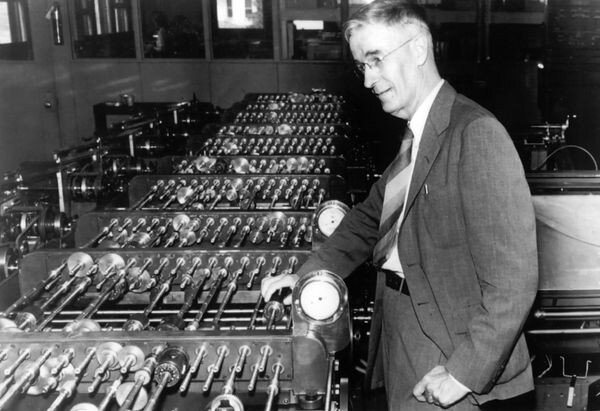
    2. The Government, Education and Technology. Babbage had suggested using punch cards for computers, but Herman Hollerith, an employee of the U.S. Census Bureau, was the first to successfully implement them. Hollerith was angered that the decennial census took eight years to successfully complete. With his new punch cards, designed to analyze combinations of traits, it took only eight. In 1924, after a series of mergers, the company Hollerith founded became IBM. This was the first involvement of the US government with computers. Next came educational institutions, namely MIT, where by 1931 Vanneaver Bush had built a Differential Analyzer (pictured below), the world’s first analog electric computing machine. This machine would be copied by the U.S. Army, University of Pennsylvania, Manchester University and Cambridge University and iterated on until the creation of the Electronic Numerical Integrator and Computer (ENIAC), which firmly established a digital future for computing machines. With World War as a motivator, the invention of the computer was driven forward by academic institutions and the government.

Business Themes

102680080-03-01.jpg
  1. Massive Technological Change is Slow. Large technological change almost always feels sudden, but it rarely ever is. Often, new technological developments are relegated to small communities, like Homebrew computing club, where Steve Wozniak handed out mock-ups for the Apple Computer, which was the first to map a keyboard to a screen for input. The development of the transistor (1947) preceded the creation of the microchip (1958) by eleven years. The general purpose chip, a.k.a. the microprocessor popped up thirteen years after that (1971), when Intel introduced the 4004 into the business world. This phenomenon was also true with the internet. Packet switching was first discovered in the early 1960s by Paul Baran, while he was at the RAND Corporation. The Transmission Control Protocol and Internet Protocol were created fifteen years after that (1974) by Vint Cerf and Bob Kahn. The HyperText Transfer Protocol (HTTP) and the HyperText Markup Language (HTML) were created sixteen years after that in 1990 by Tim Berners-Lee. The internet wasn’t in widespread use until after 2000. Introductions of new technologies often seem sudden, but they frequently call on technologies of the past and often involve a corresponding change that address the prior limiting factor of a previous technology. What does that mean for cloud computing, containers, and blockchain? We are probably earlier in the innovation cycle than we can imagine today. Business does not always lag the innovation cycle, but is normally the ending point in a series of innovations.

  2. Teams are Everything. Revolution and change happens through the iteration of ideas through collaborative processes. History provides a lot of interesting lessons when it comes to technology transformation. Teams with diverse backgrounds, complementary styles and a mix of visionary and operating capabilities executed the best. As Isaacson notes: “Bell Labs was a classic example. In its long corridors in suburban New Jersey, there were theoretical physicists, experimentalists, material scientists, engineers, a few businessmen, and even some telephone pole climbers with grease under their fingernails.” Bell Labs created the first transistor, a semiconductor that would be the foundation of Intel’s chips, where Bob Noyce and Gordon Moore (yes – Moore’s Law) would provide the vision, and Andy Grove would provide the focus.

Dig Deeper

  • Alan Turing and the Turing Machine

  • The Deal that Ruined IBM and Catapulted Microsoft

  • Grace Hopper and the First Compiler

  • ARPANET and the Birth of the Internet

tags: IBM, Microsoft, Moore's Law, Apple, Alan Turing, OpenAI, Cloud Computing, Bell Labs, Intel, MIT, Ada Lovelace, batch2
categories: Non-Fiction
 

December 2019 - The Moon is a Harsh Mistress by Robert A. Heinlein

This futuristic, anti-establishment thriller is one of Elon Musk’s favorite books. While Heinlein’s novel can drag on with little action, The Moon is a Harsh Mistress presents an interesting war story and predicts several technological revolutions.

Tech Themes

  1. Mike, the self-aware computer and IBM. Mycroft Holmes, Heinlein’s self-aware, artificially intelligent computer is a friendly, funny and focused companion to Manny, Wyoh and Prof throughout the novel. Mike’s massive hardware construction is analogous to the way companies are viewing Artificial Intelligence today. Mike’s AI is more closely related to Artificial General Intelligence, which imagines a machine that can go beyond the standard Turing Test, with further abilities to plan, learn, communicate in natural language and act on objects. The 1960s were filled with predictions of futuristic robots and machines. Ideas were popularized not only in books like The Moon is a Harsh Mistress but also in films like 2001: A Space Odyssey, where the intelligent computer, HAL 9000, attempts to overthrow the crew. In 1965, Herbert Simon, a noble prize winner, exclaimed: “machines will be capable, within twenty years, of doing any work a man can do.” As surprising as it may seem today, the dominant technology company of the 1960’s was IBM, known for its System/360 model. Heinlein even mentions Thomas Watson and IBM at Mike’s introduction: “Mike was not official name; I had nicknamed him for Mycroft Holmes, in a story written by Dr. Watson before he founded IBM. This story character would just sit and think--and that's what Mike did. Mike was a fair dinkum thinkum, sharpest computer you'll ever meet.” Mike’s construction is similar to that of present day IBM Watson, who’s computer was able to win Jeopardy, but has struggled to gain traction in the market. IBM and Heinlein approached the computer development in a similar way, Heinlein foresaw a massive computer with tons of hardware linked into it: “They kept hooking hardware into him--decision-action boxes to let him boss other computers, bank on bank of additional memories, more banks of associational neural nets, another tubful of twelve-digit random numbers, a greatly augmented temporary memory. Human brain has around ten-to-the tenth neurons. By third year Mike had better than one and a half times that number of neuristors.” This is the classic IBM approach – leverage all of the hardware possible and create a massive database of query-able information. This actually does work well for information retrieval like Jeopardy, but stumbles precariously on new information and lack of data, which is why IBM has struggled with Watson applications to date.

  2. Artificial General Intelligence. Mike is clearly equipped with artificial general intelligence (AGI); he has the ability to securely communicate in plain language, retrieve any of the world’s information, see via cameras and hear via microphones. As discussed above, Heinlein’s construction of Mike is clearly hardware focused, which makes sense considering the book was published in the sixties, before software was considered important. In contrast to the 1960s, today, AGI is primarily addressed from an algorithmic, software angle. One of the leading research institutions (excluding the massive tech companies) is OpenAI, an organization who’s mission is: “To ensure that artificial general intelligence (AGI)—by which we mean highly autonomous systems that outperform humans at most economically valuable work—benefits all of humanity.” OpenAI was started by several people including Elon Musk and Sam Altman, founder of Y Combinator, a famous startup incubator based in Silicon Valley. OpenAI just raised $1 billion from Microsoft to pursue its artificial algorithms and is likely making the most progress when it comes to AGI. The organization has released numerous modules that allow developers to explore the wide-ranging capabilities of AI, from music creation, to color modulation. But software alone is not going to be enough to achieve full AGI. OpenAI has acknowledged that the largest machine learning training runs have been run on increasingly more hardware: “Of course, the use of massive compute sometimes just exposes the shortcomings of our current algorithms.” As we discussed before (companies are building their own hardware for this purpose, link to building their own hardware), and the degradation of Moore’s Law imposes a serious threat to achieving full Artificial General Intelligence.

  3. Deep Learning, Adam Selene, and Deep Fakes. Heinlein successfully predicted machine’s ability to create novel images. As the group plans to take the rebellion public, Mike is able to create a depiction of Adam Selene that can appear on television and be the face of the revolution: “We waited in silence. Then screen showed neutral gray with a hint of scan lines. Went black again, then a faint light filled middle and congealed into cloudy areas light and dark, ellipsoid. Not a face, but suggestion of face that one sees in cloud patterns covering Terra. It cleared a little and reminded me of pictures alleged to be ectoplasm. A ghost of a face. Suddenly firmed and we saw "Adam Selene." Was a still picture of a mature man. No background, just a face as if trimmed out of a print. Yet was, to me, "Adam Selene." Could not he anybody else.” Image generation and manipulation has long been a hot topic among AI researchers. The research frequently leverages a technique called Deep Learning, which is a play on classically used Artificial Neural Networks. A 2012 landmark paper from the University of Toronto student Ilya Sutskever, who went on to be a founder at OpenAI, applied deep learning to the problem of image classification with incredible success. Deep learning and computer vision have been inseparable ever since. One part of research focuses on a video focused image superimposition technique called Deep Fakes, which became popular earlier this year. As shown here, these videos are essentially merging existing images and footage with a changing facial structure, which is remarkable and scary at the same time. Deep fakes are gaining so much attention that even the government is focused on learning more about them. Heinlein was early to the game, imaging a computer could create a novel image. I can only imagine how he’d feel about Deep Fakes.

Business Themes

correspondence.jpg
news-20190228.gif
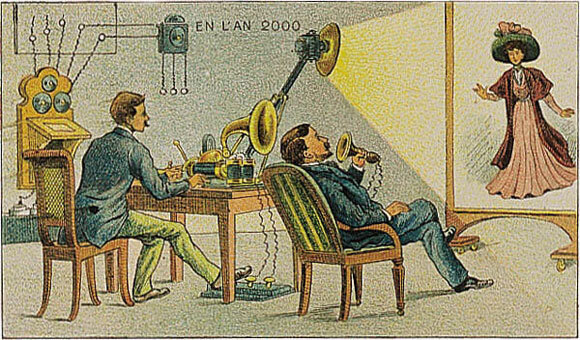
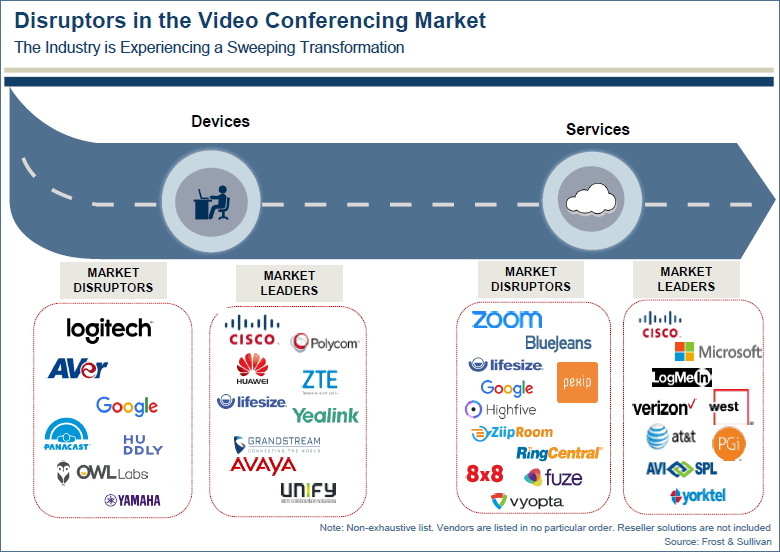
  1. Video Conferencing. Manny and the rest of the members of the revolution communicate through encrypted phone conversations and video conferences. While this was certainly ahead of its time, video conferencing was first imagined in the late 1800s. Despite a clear demand for the technology, it took until the late 2000s arguably, to reach appoint where mass video communication was easily accessible for businesses (Zoom Video) and individuals (FaceTime, Skype, etc.) This industry has constantly evolved and there are platforms today that offer both secure chat and video such as Microsoft Teams and Cisco Webex. The entire industry is a lesson in execution. The idea was dreamed up so long ago, but it took hundreds of years and multiple product iterations to get to a de-facto standard in the market. Microsoft purchased Skype in 2011 for $8.5B, the same year that Eric Yuan founded Zoom. This wasn’t Microsoft’s first inroads into video either, in 2003, Microsoft bought Placeware and was supposed to overtake the market. But they didn’t and Webex continued to be a major industry player before getting acquired by Cisco. Over time Skype popularity has waned, and now, Microsoft Teams has a fully functioning video platform separate from Skype – something that Webex did years ago. Markets are constantly in a state of evolution, and its important to see what has worked well. Skype and Zoom both succeeded by appealing to free users, Skype initially focused on free consumers, and Zoom focused on free users within businesses. WebEx has always been enterprise focused but they had to be, because bandwidth costs were too high to support a video platform. Teams will go to market as a next-generation alternate/augmentation of Outlook; it will be interesting to see what happens going forward.

  2. Privacy and Secure Communication. As part of the revolution’s communication, a secure, isolated message system is created whereby not only are conversations fully encrypted and undetected by authorities but also individuals are unable to speak with more than two others in their revolution tree. Today, there are significant concerns about secure communication – people want it, but they also do not. Facebook has declared that they will implement end to end encryption despite warnings from the government not to do so. Other mobile applications like Telegram and Signal promote secure messaging and are frequently used by reporters for anonymous tips. While encryption is beneficial for those messaging, it does raise concerns about who has access to what information. Should a company have access to secure messages? Should the government have access to secure messages? Apple has always stayed strong in its privacy declaration, but has had its own missteps. This is a difficult question and the solution must be well thought out, taking into account unintended consequences of sweeping regulation in any direction.

  3. Conglomerates. LuNoHo Co is the conglomerate that the revolution utilized to build a massive catapult and embezzle funds. While Mike’s microtransaction financial fraud is interesting (“But bear in mind that an auditor must assume that machines are honest.”), the design of LuNoHo Co. which is described as part bank, part engineering firm, and part oil and gas exploitation firm, interestingly addresses the conventional business wisdom of the times. In the 1960s, coming out of World War II, conglomerates began to really take hold across many developing nations. The 1960s were a period of low interest rates, which allowed firms to perform leveraged buyouts of other companies (using low interest loans), sometimes in a completely unrelated set of industries. Activision was once part of Vivendi, a former waste management, energy, construction, water and property conglomerate. The rationale for these moves was often that a much bigger organization could centralize general costs like accounting, finance, legal and other costs that touched every aspect of the business. However, when interest rates rose in the late 70s and early 80s, several conglomerate profits fell, and the synergies promised at the outset of the deal turned out to be more difficult to realize than initially assumed. Conglomerates are incredibly popular in Asia, often times supported by the government. In 2013, McKinsey estimated: “Over the past decade, conglomerates in South Korea accounted for about 80 percent of the largest 50 companies by revenues. In India, the figure is a whopping 90 percent. Meanwhile, China’s conglomerates (excluding state-owned enterprises) represented about 40 percent of its largest 50 companies in 2010, up from less than 20 percent a decade before.” Softbank, the famous Japanese conglomerate and creator of the vision fund, was originally a shrink-wrap software distributor but now is part VC and part Telecommunications provider. We’ve discussed the current state of Chinese internet conglomerates, Alibaba and Tencent who each own several different business lines. Over the coming years, as internet access in Asia grows more pervasive and the potential for economic downturn increases, it will be interesting to see if these conglomerates break apart and focus on their core businesses.

Dig Deeper

  • The rise and fall of Toshiba

  • Using Artificial Intelligence to Create Talking Images

  • MIT Lecture on Image Classification via Deep Learning

  • 2019 Trends in the Video Conferencing Industry

  • The Moon is a Harsh Mistress may be a movie

tags: Facebook, IBM, Zoom, Artificial Intelligence, AI, AGI, Watson, OpenAI, Y Combinator, Microsoft, Moore's Law, Deep Fakes, Deep Learning, Elon Musk, Skype, WebEx, Cisco, Apple, Activision, Conglomerate, Softbank, Alibaba, Tencent, Vision Fund, China, Asia, batch2
categories: Fiction
 

About Contact Us | Recommend a Book Disclaimer