• Tech Book of the Month
  • Archive
  • Recommend a Book
  • Choose The Next Book
  • Sign Up
  • About
  • Search
Tech Book of the Month
  • Tech Book of the Month
  • Archive
  • Recommend a Book
  • Choose The Next Book
  • Sign Up
  • About
  • Search

October 2023 - The Outsiders by Will Thorndike

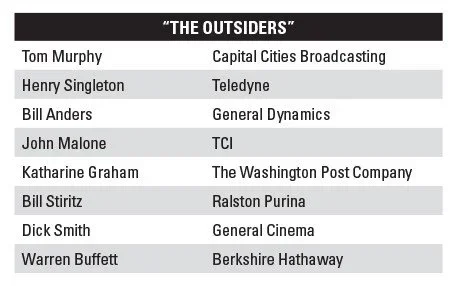
This month we read an absolute classic on capital allocation. Nothing says Outsider like multiple family businesses and white male HBS graduate CEOs! To be fair, many were “outsiders” to their industry. Either way, its a short and compelling read. Thorndike makes the point early in the book that this group of companies has outperformed the S&P over a prolonged period - but as an LP once said: “I’ve never seen a bad backtest.” I don’t view any of the practices in this book as rigid. These are not hammers to a nail, these are options for any executive considering the best use of cash.

Tech Themes

  1. No straight lines. As is the case with many a business book, success is often portrayed as linear, despite being filled with the ups and downs that are natural in life. For example, when a young Tom Murphy took over a struggling radio station in Albany, he had to tightly manage the company through YEARS of operating losses, before he could turn on the offensive and start acquiring small competitors and buying back stock. Eventually, the cash generated from his businesses allowed him to acquire ABC for $3.5B in 1986, in a large extremely successful acquisition. Other Outsider CEOs also experienced challenges. Dick Smith’s General Cinema spin-off GCC went bankrupt in the late 1990s, as the cinema business became more competitive. Despite being an incredible CEO and capital allocator, Smith failed to save the initial company that generated the cash to build his business. When Bill Anders walked through the front door on his first day at General Dynamics, the company was bleeding cash, had a $600m mountain of debt, and a market cap of $1B despite $10B in annual revenues. Katharine Graham was thrust into the role of CEO at the Washington Post after her husband Philip Graham passed away. She was a mother of four, with little operating experience, stepping into the CEO role at a Fortune 500 company. Even the best CEOs experience the intensity of failing businesses, learning to push through the noise and emerge on the other side in tact can create the skill and resilience needed to thrive.

  2. Improving Operations. Every CEO mentioned in the book was obsessive about improving operations and watching costs. Teledyne took a unique approach to driving operational discipline - they decentralized the organization. Driven by the need to diversify out of core businesses due to very restrictive M&A laws, the companies of the conglomerate era often acquired extremely diverse business interests and centralized operations to yield “synergies.” Teledyne took the opposite approach. Rather than rolling everything into one big corporate headquarters, they kept HQ lean, and pushed accountability and responsibility deep into their industrial subsidiaries. The result, managers that ran their organizations like owners, something Mark Leonard would be proud of. Bill Stiritz at Ralston Purina took a very aggressive approach to operational discipline. As Thorndike puts it: “Businesses that could not generate acceptable returns were sold (or closed). These divestitures included underperforming food brands (including the Van de Kamp’s frozen seafood division, a rare acquisition mistake) and the company’s legacy agricultural feed business.” Not only was Stiritz a hawk, carefully curating and watching his best business units, but he also was willing to let go of past mistakes to improve the core. This mental flexibility, and being able to not tie himself to an acquisition showed his extreme discipline in how he ran Ralston Purina. For a long time, the venture capital industry has provided substantial sums of cash to successful startups at ever climbing valuations, but these waves of cash can erode operational discipline that make CEOs great. We’ve seen a few companies (like Meta) embrace a new wave of efficiency

  3. Winner Takes Most. Tom Murphy and Dan Burke were the perfect capital allocator (Tom) and disciplined operating executive (Dan) pair. They also knew Capital Cities business inside and out, to a point where they could truly understand the market, in a way only a competent insider with large swaths of information could. Thorndike writes: “Murphy and Burke realized that the key drivers of profitability in most of their businesses were revenue growth and advertising market share. For example, Murphy and Burke realized early on that the TV station that was number one in local news ended up with a disproportionate share of the market’s advertising revenue. As a result, Capital Cities stations always invested heavily in news talent and technology.” This idea around disproportionate share can also be called “Winner takes most,” and most software markets exhibit this dynamic. There are several reasons for this including Economies of Scale, Standardization, and Perceived Safety. Let’s take Atlassian’s Jira and Confluence through this lens. Because Atlassian is the largest provider of Product Management and Wiki software, it can spread its R&D costs across a very large number of users. The larger it gets, the lower per user cost it maintains. With the low distribution costs that software has, Atlassian can continually price its software extremely competitively to a point where its the best value (price to value received by customer) on the market. Software markets also tend to standardize on formats: think VHS vs. Betamax, HD DVD vs. Blue Ray, Apple vs. Microsoft/Intel. If the market is massive, there can be multiple winners (like Apple vs. Android or the three cloud providers). But once you become a standard in a medium to large sized market, it can be very difficult to flip that standard, because it takes re-jiggering the entire value chain. For example, a new product management software would mean software engineers, product/engineering managers, designers, and executives would need to all flip to a new standard. Its the reason Autodesk maintains a large market share, 40 years after the founding of AutoCAD. And this bring us to our last point, Perceived Safety. Brands are based on perceptions. Standards create the perception of safety - that they will exist in 10 years, that the executive choosing the standard won’t be fired for that choice, that the software will work at scale. Everyone hates on Jira, just like they hate on AutoCAD, or Salesforce, or Oracle. But these companies have all become standards, and individuals perceive standards as safe. Winner takes most markets are all about building that strong combination of price and value.

Business Themes
Outsiders_CEOs.webp
  1. Buybacks, Acquisitions, Divestitures. One common trait from the outsider CEOs is not being shy when the market presents an incredible deal. Thorndike attempts to portray this as executives walking through simple math to come to straight forward conclusions. However, I believe this comes down to knowing exactly what you want. Tom Murphy, for example, kept a list of A+ assets he’d like to acquire (at a reasonable price) and waited until the time came, which is reminiscent of Chris Hohn’s approach too. Not that they couldn’t be flexible in approaching a new deal, but more that they had a very strong inkling of what and how financial returns could work and knew the competitive positioning of the assets they were purchasing deeply. Henry Singleton knew no business better than his own, and he flexed that muscle whenever the market gave him an opportunity to do so. As Thorndike says: “Henry Singleton is the Babe Ruth of repurchases… between 1972 and 1984, in eight separate tender offers, he bought back an astonishing 90% of Teledyne’s outstanding shares.” And Henry was not afraid of size nor leverage. “In May of 1980, with Teledyne’s P/E multiple near an all time low, Singleton initiated the comapny’s largest tender yet, which was oversubscribed by threefold. Singleton decided to buy all the tendered shares (over 20% of shares outstanding), and given the company’s strong free cash flow and a recent drop in interest rates, financed the entire repurchase with fixed rate debt.” We must be clear that buybacks are not always the right move and include many frictional costs that mean that not all shareholder dollars are being spent directly on share repurchases. Bill Stiritz of Ralston Purina was also not afraid to buy in size: “When the opportunity to buy Energizer came up, a small group of us met at 1:00pm and got the seller’s books. We performed a back of the envelope LBO model, met again at 4:00pm and decided to bid $1.4B”. Ralston would later spin Energizer Holdings out in 2000 for ~$2.1B, after selling off some smaller pieces of the business. About 20 months later, Ralston sold itself to Nestle for $10.3B. Stirtiz then began another consumer brands conglomerate with Post Holdings. Here, Stiritz was a buyer at one price, a seller at another, and a seller of his whole business at a huge take out price. At General Dynamics, Bill Anders refocused the company on areas where it could maintain a dominant market position. For example, General Dynamics owned the much lauded F-16 fighter plane division, but it was much smaller than industry counterpart Lockheed Martin. When Lockheed’s CEO offered him $1.5B for the division, an extremely high price (at the time), Anders sold it on the spot. Thorndike notes: “Anders made the rational business decision, the one that was consistent with growing per share value, even though it shrank his company to less than half its former size and robbed him of his favorite perk as CEO: the opportunity to fly the company’s cutting edge jets.” Looking back, the F16 went on to be a staple fighter plane in many militaries around the world, with individual contracts totaling well above $10B. I wonder if Anders still believes this was the best course of action for the company. It certainly saved it in the short term, but GD missed out on years of revenue from the F-16. Either way, Anders, along with other outsider CEOs weren’t afraid to shrink the company or grow the company via acquisitions, buybacks, and divestitures. Talk about the big acquisitions, big buybacks, big divestitures. Ralston-Energizer, Teledyne buying back a ton, Dick Smith buys and sales and spins.

  2. Best Ideas Win. The outsider CEOs were totally willing to let others influence their decision making. Dick Smith created an Office of the Chairman, consisting of Chief Final Officer Woody Ives, Chief Operating Officer Bob Tarr, and corporate counsel Sam Frankenheim. As Thorndike writes: “Woody Ives, the company’s talented CFO, remembers one of his proudest moments at General Cinema (Ives later left to lead a successful turnaround at Eastern Resources), when a joint venture to enter the cable business with Comcast and CBS was shot down by the board after Smith let Ives voice a dissenting opinion: ‘He gave me permission to publicly disagree with him in front of the Board. Very few CEOs would have done that.” These CEOs thought logically, whether it was with the crowd or against. Henry Singleton put it well: “I know a lot of people have very strong and definite plans they’ve worked out all on all kinds of things, but we’re subject to a tremendous number of outside influences and the vast majority of them cannot be predicted. So my idea is to stay flexible.” Singleton and Buffett both shared a somewhat innate value orientation. When Leon Cooperman asked a retired Henry Singleton about the large number of share repurchases occurring at Fortune 500 companies, Henry responded: “If everyone’s doing them, there must be something wrong with them.” Many of the outsider CEOs also had unique ways of looking at the financials of their businesses. Singleton and CFO Jerry Jerome created a “Teledyne Return” which averaged cash flow and net income for each business unit and served as the basis for bonus compensation for all business unit managers. The Teledyne return idea is similar to Mark Leonard’s ROIC compensation scheme. Driven by his absolute disdain of taxes, John Malone at TCI introduced Earnings before interest, taxes, depreciation, and amortization (EBITDA), as an alternative to reported earnings (Net income). Higher net income meant higher taxes and Malone liked to use leverage on his telecom buildouts to utilize debt’s natural interest tax shield. Dick Smith used cash earnings (net earnings + depreciation) when evaluating the success of his business units. Tom Murphy preferred ROIC: “The goal is not to have the longest train but to arrive at the station first using the least fuel.” The outsider CEOs thought independently and acted in accordance with anyone around the tables best ideas.

  3. War time CEO. Not every decision these CEOs made went swimmingly. Teledyne faced an accounting probe, Dick Smith’s GCC went bankrupt, Bill Anders sold off a long-time winner to alleviate short term pressure, Bill Stiriz sold off Jack in the Box for $450m (now worth $4.5b) and the St. Louis Blues for $12m (now worth $1.3B), Warren Buffett acquired Dexter Shoe Company using 25,203 shares of stock (now worth $17B). When things got tough or extreme, they weren’t afraid to step back in to help in crucial moments. In the third quarter of 1996, TCI badly missed on its forecasts, losing subscribers for the first time and showing a decline in cash flow. “Malone, disappointed by these results reassumed the helm, and uncharacteristically, took direct management control of operations, quickly reducing employee head count by 2,500, halting all orders for capital equipment, and aggressively renegotiating programming contracts. He also fired the consultants who had been hired to help with the system upgrade, and returned responsibility for customer service to the local system managers.” Malone became the wartime CEO that Ben Horowitz discussed in The Hard Thing About Hard Things. Singleton retired from the chairman role at Teledyne in 1991 but “returned in 1996 to negotiate the merger of Teledyne’s manufacturing operations with Allegheny Industries and fend off a hostile takeover bid by raider Bennett LeBow.” Challenges inevitably strike every single business. As Bill Gurley likes to quip: “Every company eventually trades for 13x earnings.” His point being, that every company faces a moment where investors sour dramatically on the business’s future prospects. I’d even extend this to: “Every company eventually makes a compelling short.” Even some of the most vaunted businesses like Rollins, have stumbled into earnings management issues and become the focal point of short reports in recent years. If we think about businesses as complex, three dimensional functions, some portion of that function exists where market and business fundamentals eventually move against the company. Several outsider CEOs took that opportunity to jump back into the fire, and sort through the troubles, to land their businesses on the other side of the fray safely.

    Dig Deeper

  • The Singular Henry Singleton (1979)

  • CNBC’s full interview with Liberty Media’s John Malone on interest rates and industry outlook

  • Ralston’s Perilous ‘Middle Innings’ (1985)

  • General Cinema’s Big Bet on Harcourt Brace’s Revival (1992)

  • Remembering Katharine Graham on Charlie Rose (2001)

tags: Will Thorndike, Tom Murphy, Capital Cities, General Cinema, Dick Smith, Katharine Graham, Washington Post, Teledyne, Decentralization, Henry Singleton, Mark Leonard, Bill Stiritz, Ralston Purina, Dan Burke, Atlassian, Autodesk, Salesforce, Oracle, Chris Hohn, Energizer Holdings, Post Holdings, Bill Anders, General Dynamics, Lockheed Martin, John Malone, TCI, Warren Buffett, Berkshire Hathaway, ROIC, Rollins, Jack in the Box, Ben Horowitz
categories: Non-Fiction
 

May 2023 - Constellation Software Letters by Mark Leonard

We cover Canada’s biggest and quietest software company and their brilliant leader Mark Leonard.

Tech Themes

  1. Critics and Critiques. For a long time, Constellation heard the same critiques: Roll-ups never work, the businesses you are buying are old, the markets you are buying in are small, the delivery method of license/maintenance is phasing out. All of these are valid concerns. Constellation is a roll-up of many software businesses. Roll-ups, aka acquiring several businesses as the primary method of growth, do have tendency to blow up. The most frequent version for a blowup is leverage. Companies finance acquisitions with debt and eventually they make a couple of poor acquisition decisions and the debt load is too big, and they go bankrupt. A recent example of this is Thrashio, an Amazon third party sellers roll-up. RetailTouchPoints lays out the simple strategy: “Back in 2021, firms like Thrasio were able to buy these Amazon-based businesses for around 4X to 6X EBITDA and then turn that into a 15X to 25X valuation on the combined business.” However, demand for many of these products waned in the post-pandemic era, and Thrasio had too much debt to handle with the lower amount of sales. Bankruptcy isn’t all bad - several companies have emerged from bankruptcy with restructured debt, in a better position than before. To avoid the issue of leverage, Constellation has never taken on meaningful (> 1-2x EBITDA) leverage. This may change in the coming years, but for now it remains accurate. Concerns around market size and delivery method (SaaS vs. License/Maintenance) are also valid. Constellation has software businesses in very niche markets, like boating maintenance software that are inherently limited in size. They will never have a $1B revenue boat maintenance software business, the market just isn’t that big. However, the lack of enthusiasm over a small niche market tends to offer better business characteristics - fewer competitors, more likely adoption of de-facto technology, highly specialized software that is core to a business. Constellation’s insight to combine thousands of these niche markets was brilliant. Lastly, delivery methods have changed. Most customers now prefer to buy cloud software, where they can access technology through a browser on any device and benefit from continuous upgrades. Furthermore, SaaS businesses are subscriptions compared to license maintenance businesses where you pay a signficant sum for the license up-front and then a correspondingly smaller sum for maintenance. SaaS subscriptions tend to cost more over the long-term and have less volatile revenue spikes, but can be less profitable because of the need to continuously improve products and provide the service 24/7. Interestingly, Constellation continued to avoid SaaS even after it was the dominant method of buying software. From the 2014 letter: “The SaaS’y businesses also have higher organic growth rates in recurring revenues than do our traditional businesses. Unfortunately, our SaaS’y businesses have higher average attrition, lower profitability and require a far higher percentage of new name client acquisition per annum to maintain their revenues. We continue to buy and invest in SaaS businesses and products. We'll either learn to run them better, or they will prove to be less financially attractive than our traditional businesses - I expect the former, but suspect that the latter will also prove to be true.” While 2014 was certainly earlier in the cloud transformation, its not surprising that an organization built around the financial characteristics of license maintenance software struggled to make this transition. They are finally embarking on this journey, led their by their customers, and its causing license revenue to decline. License revenue has declined each of the last six quarters. The critiques are valid but Constellations assiduousness allowed them to side-step and even benefit from these critics as they scaled.

  2. Initiatives, Investing for Organic Growth, and Measurement. Although Leonard believes that organic growth is an important measure of success of a software company, he lays out in the Q1’07 letter the challenges of Constellation’s internal organic growth projects, dubbed Initiatives. “In 2003, we instituted a program to forecast and track many of the larger Initiatives that were embedded in our Core businesses (we define Initiatives as significant Research & Development and Sales and Marketing projects). Our Operating Groups responded by increasing the amount of investment that they categorized as Initiatives (e.g. a 3 fold increase in 2005, and almost another 50% increase during 2006). Initially, the associated Organic Revenue growth was strong. Several of the Initiatives became very successful. Others languished, and many of the worst Initiatives were terminated before they consumed significant amounts of capital.” The last sentence is the hardest one to stomach. Terminating initiatives before they had consumed lots of capital, is the smart thing to do. It is the rational thing to do. However, I believe this is at the heart of why Constellation has struggled with organic growth over time. Now I’ll be the first to admit that Constellation’s strategy has been incredible, and my criticism is in no way taking that away from them. Frankly, they won’t care what I say. But, as a very astute colleague pointed out to me, this position of measuring all internal R&D and S&M initiatives, is almost self-fulfilling. At the time Leonard wasn’t concerned with the potential for lack of internal investment and organic growth. He even remarked as so: “I’m not yet worried about our declining investment in Initiatives because I believe that it will be self-correcting. As we make fewer investments in new Initiatives, I’m confident that our remaining Initiatives will be the pick of the litter, and that they are likely to generate better returns. That will, in turn, encourage the Operating Groups to increase their investment in Initiatives. This cycle will take a while to play out, so I do not expect to see increased new Initiative investment for several quarters or even years.” By 2013, he had changed his tune: “Organic growth is, to my mind, the toughest management challenge in a software company, but potentially the most rewarding. The feedback cycle is very long, so experience and wisdom accrete at painfully slow rates. We tracked their progress every quarter, and pretty much every quarter the forecast IRR's eroded. Even the best Initiatives took more time and more investment than anticipated. As the data came in, two things happened at the business unit level: we started doing a better job of managing Initiatives, and our RDSM spending decreased. Some of the adaptations made were obvious: we worked hard to keep the early burn-rate of Initiatives down until we had a proof of concept and market acceptance, sometimes even getting clients to pay for the early development; we triaged Initiatives earlier if our key assumptions proved wrong; and we created dedicated Initiative Champion positions so an Initiative was less likely to drag on with a low but perpetual burn rate under a part-time leader who didn’t feel ultimately responsible. But the most surprising adaptation, was that the number of new Initiatives plummeted. By the time we stopped centrally collecting Initiative IRR data in Q4 2010, our RDSM spending as a percent of Net Revenue had hit an all-time low.” So how could the most calculating, strategic software company of maybe all time struggle to produce attractive organic growth prospects? I’d argue two things - 1) Incentives and 2) Rationality. First, on incentives, the Operating Group managers are compensated on ROIC and net revenue growth. If you are a BU manager and could invest in your business vs. buy another company that has declining organic growth but is priced appropriately (i.e. cheaply) requiring minimal capital outlay, you achieve both objectives by buying lower organic growers or even decliners. It is almost similar to buying ads to fill a hole in churned revenue. As long as you keep pressing the advertising button, you will keep gathering customers. But when you stop, it will be painful and growth will stall out. If I’m a BU manager buying meh software companies that achieve good ROIC and I’m growing revenues because of my acquisitions, it just means I need to keep finding more acquisitions to achieve my growth hurdles. Over time this is a challenge, but it may be multiple years before I have a bad acquisition growth year. Clearly, the incentives are not aligned for organic growth. Connected to the first point, the “buy growth for low cash outlays” strategy is perfectly rational based on the incentives. The key to its rationality is the known vs. the unknown. In buying a small, niche VMS business - way more is known about the range of outcomes. If you compare this to an organic growth initiative, it is clear why again, you choose the acquisition path. Organic growth investments are like venture capital. If sizeable, they can have an outsized impact on business potential. However, the returns are unknown. Simple probability illustrates that a 90% chance of a 20% ROIC and a 10% chance of a 10% ROIC, yields a 19% ROIC. I’d argue however, that with organic initiatives, particularly large, complex organic initiatives, there is an almost un-estimable return. If we use Amazon Web Services as perhaps the greatest organic growth initiative ever produced we can see why. Here is a reasonably capital-intensive business outside the core of Amazon’s online retailing applications. Sure, you can claim that they were already using AWS internally to run their operations, so the lift was not as strong. But it is still far afield from bookselling. AWS as an investment could never happen inside of Constellation (besides it being horizontal software). What manager is going to tank their ROIC via a capital-intensive initiative for several years to realize an astronomical gain down the line? What manager is going to send back to Constellation HQ, that they found a business that has the potential for $85B in revenue and $20B in operating profit 15 years out? You may say, “Vertical markets are small, they can’t produce large outcomes.” Constellation started after Veeva, a $30B public company, and Appfolio, a $7.5B company. The crux of the problem is that it is impossible to measure via a spreadsheet, the unknown and unknowable expected returns of the best organic growth initiatives. As Zeckhauser has discussed, the probabilities and associated gains/losses tend to be severely mispriced in these unknown and unknowable situations. Clayton Christensen identified this exact problem through his work on disruptive innovation. He urged companies to focus on ideas, failure, and learning, noting that strategic and financial planning must be discovery-based rather than execution based. Maybe there were great initiatives within Constellation that never got launched because incentives and rationality stopped them in their tracks. It’s not that you should burn the boats and put all your money into the hot new thing, it’s that product creation and organic growth are inherently risky ventures, and a certain amount of expected loss can be necessary to find the real money-makers.

  3. Larger deals. Leonard stopped writing annual letters, but broke the streak in 2021, when he penned a short note, outlining that the company would be pursuing more larger deals at lower IRRs and looking to develop a new circle of competence outside of VMS. I believe his words were chosen carefully to reflect Warren Buffett’s discussion of Circle of Competence and Thomas Watson Sr.’s (founder of IBM) quote: “I’m no genius. I’m smart in spots - but I stay around those spots.” While I appreciate the idea behind it, I’m less inclined to stay within my circle of competence. I’m young, curious, and foolish, and I think it would be a waste to pigeon-hole myself so early. After all, Warren had to learn about insurance, banking, beverages, etc and he didn’t let his not-knowing preclude him from studying. In justifying larger deals, Leonard cited Constellation’s scale and ability to invest more effectively than current shareholders. He also laid out the company’s edge: “Most of our competitors maximise financial leverage and flip their acquisitions within 3-7 years. CSI appreciates the nuances of the VMS sector. We allow tremendous autonomy to our business unit managers. We are permanent and supportive stakeholders in the businesses that we control, even if their ultimate objective is to eventually be a publicly listed company. CSI’s unique philosophy will not appeal to all sellers and management teams, but we hope it will resonate with some.” Since then Constellation has acquired Allscript’s hospital unit business in March 2022 for $700m in cash, completed a spin-merger of Lumine Group into larger company, WideOrbit, to create a publicly traded telecom advertising software provider, and is rumored to be looking at purchasing a subsidiary of Black Knight, which may have to be divested for its own transaction with ICE. These larger deals no doubt come with more complexity, but one large benefit is they sit within larger operating groups, and are shielded during what may be difficult transition periods for the businesses. It allows the businesses to operate more long-term and focus on providing value to end customers. As for deals outside of VMS, Mark Leonard commented on it during the 2022 earnings call: “I took a hard look at a thermal oil situation. I was looking at close to $1B investment, and it was tax advantaged. So it was a clever structure. It was a time when the sector could not get financing. And unfortunately, the oil prices ran away on me. So I was trying to be opportunistic in a sector that was incredibly beat up. So that is an example….So what are the characteristics there? Complexity. Where its a troubled situation with — circumstances and there’s a lot of complexity. I think we can compete better than the average investor, particularly when people are willing to take capital forever.” The remark on complexity reminded me of Baupost, the firm founded by legendary investor Seth Klarman, who famously bought claims on Lehman Brothers Europe following the 2008 bankruptcy. When you have hyper rational individuals, complexity is their friend.

Business Themes

types_of_motivation.jpg
  1. Decentralized Operating Groups. Its safe to say that Mark Leonard is a BIG believer in decentralized operating groups. Constellation believes in pushing as much decision making authority as possible to the leaders of the various business units. The company operates six operating groups: Volaris, Harris, Topicus (now public), Jonas, Perseus, and Vela. Leonard mentioned the organizational structure in the context of organic growth: “When most of our current Operating Group Managers ran single BU’s, they had strong organic growth businesses. As those managers gave up their original BU management position to oversee a larger Group of BU’s (i.e. became Portfolio Managers), the organic growth of their original BU’s decreased and the profitability of those BU’s increased.” As an example of this dynamic, we can look at Vencora, a Fintech subsidiary of Volaris. Vencora is managed by a portfolio manager, itself a collection of Business Units (BUs) with their own leadership. The Operating Group leaders and Portfolio Managers are incentivized based on growth and ROIC. Furthermore, Constellation mandates that at least 25% (for some executives its 75%) of incentive compensation must be used to purchase shares in the company, on the open market. These shares cannot be sold for three years. This incentive system accomplishes three goals: It keeps broad alignment toward the success of Constellation as a whole, it avoids stock dilution, and it creates a system where employees continuously own more and more of the business. Acquisitions above $20M in revenue must be approved by the head office, who is constantly receiving cash from different subsidiaries and allocating to the highest value opportunities. At varying times, the company has instituted “Keep your capital” initiatives, particularly for the Volaris and Vela operating groups. As Leonard points out in the 2015 letter: “One of the nice side effects of the “keep your capital” restriction, is that while it usually drives down ROIC, it generates higher growth, which is the other factor in the bonus formula. Acquisitions also tend to create an attractive increase in base salaries as the team ends up managing more people, capital, BUs, etc. Currently, a couple of our Operating Groups are generating very high returns without deploying much capital and we are getting to the point that we’ll ask them to keep their capital if they don’t close acceptable acquisitions or pursue acceptable Initiatives shortly.” Because bonuses are paid on ROIC, if an operating group manager sends back a ton of cash to corporate and doesn’t do a lot of new acquisitions, then its ROIC is very high and bonuses will be high. However, because Volaris and Vela are so large, it does not benefit the Head Office to continuously receive these large dividend payments and then pay high bonuses. Head Office will have a mountain of cash with out a lot of easy opportunities to deploy it. Thus the Keep your Capital initiative tamps down bonuses (by tamping down ROIC) and forces the leaders of these businesses to search out productive ways to deploy capital. As a result, more internal growth initiatives are likely to be funded, when acquisitions remain scarce, thereby increasing organic growth. It also pushes BUs and Portfolio Managers to seek out acquisitions to use up some of the capital. Overall, the organizational structure gives extreme authority to individuals and operates with large and strong incentives toward M&A and ROIC.

  2. Selling Constellation. We all know about the epic “what would have happened” deals. A few that come to mind, Oracle buying TikTok US, Microsoft buying Yahoo for $55B, Yahoo acquiring Facebook, Facebook acquiring Snapchat, AT&T acquiring T-Mobile for $39B, JetBlue/Spirt, Ryanair/Aer Lingus. There are tons. Would you believe that Constellation was up for sale at one point? On April 4th 2011, the Constellation board announced that it was considering alternatives for the company. The company was $630m of revenue and $116m of Adj. EBITDA, growing revenue 44% year over year. Today, Constellation is $8.4B of revenue, with $1.16B of FCFA2S, growing revenue at 27% year over year. At the time, Leonard lamented: “I’m proud of the company that our employees and shareholders have built, and will be more than a little sad if it is sold.” To me, this is a critically important non-event to investigate. It goes to show that any company can prematurely cap its compounding. Today, Constellation is perhaps the most revered software company with the most beloved, mysterious genius leader. Imagine if Constellation had been bought by Oracle or another large software company? Where would Mark Leonard be today? Would we have the behemoth that exists today? After the process was concluded with no sale, Leonard discussed the importance of managing one’s own stock price. “I used to maintain that if we concentrated on fundamentals, then our stock price would take care of itself. The events of the last year have forced me to re-think that contention. I'm coming around to the belief that if our stock price strays too far (either high or low) from intrinsic value, then the business may suffer: Too low, and we may end up with the barbarians at the gate; too high, and we may lose previously loyal shareholders and shareholder-employees to more attractive opportunities.” Many technology CEOs could learn from Leonard, preserving an optimistic tone when the company is struggling or the market is punishing the company, and a pessimistic tone when the company is massively over-achieving, like COVID.

  3. Metrics. Leonard loves thinking about and building custom metrics. As he stated in the Q4’2007 letter, “Our favorite single metric for measuring our corporate performance is the sum of ROIC and Organic Net Revenue Growth (“ROIC+OGr”).” However, he is constantly tinkering and thinking about the best and most interesting measures. He generally focuses on three types of metrics: growth, profitability, and returns. For growth, his preferred measure is organic growth. He also believes net maintenance growth is correlated with the value of the business. “We believe that Net Maintenance Revenue is one of the best indicators of the intrinsic value of a software company and that the operating profitability of a low growth software business should correlate tightly to Net Maintenance Revenues.” I believe this correlation is driven by maintenance revenue’s high profitability and association with high EBITA levels (Operating income + amortization from intangibles). For profitability metrics, Leonard for a long time preferred Adj. Net Income (ANI) or EBITA. “ One of the areas where generally accepted accounting principles (“GAAP”) do a poor job of reflecting economic reality, is with goodwill and intangibles accounting. As managers we are at least partly to blame in that we tend to ignore these “expenses”, focusing on EBITA or EBITDA or “Adjusted” Net Income (which excludes Amortisation). The implicit assumption when you ignore Amortisation, is that the economic life of the asset is perpetual. In many instances (for our business) that assumption is correct.” He floated the idea of using free cash flow per share, but it suffers from volatility depending on working capital payments and doesn’t adjust for minority interest payments. Adj. Net Income does both of these things but doesn’t capture the actual cash into the business. In Q3’2019, Leonard adopted a new metric called Free Cash Flow Available to Shareholders (FCFA2S): “We calculate FCFA2S by taking net cash flow from operating activities per IFRS, subtracting the amounts that we spend on fixed assets and on servicing the capital we have sourced from other stakeholders (e.g. debt providers, lease providers, minority shareholders), and then adding interest and dividends earned on investments. The remaining FCFA2S is the uncommitted cashflow available to CSI's shareholders if we made no further acquisitions, nor repaid our other capital-providing stakeholders.” FCFA2S achieves a few happy mediums: 1) Similar to ANI, it is net of the cost of servicing capital (interest, dividends, lease payments) 2) It captures changes in working capital, while ANI does not 3) It reflects cash taxes as opposed to current taxes deducted from pre-tax income (this gets at a much more confusing discussion on deferred tax assets and the difference between book taxes and cash taxes) 4) When comparing FCFA2S to CFO, it tends to be closer than comparing ANI to reported net income. For return metrics, Leonard prefers ROIC (ANI/Average Invested Capital). In the 2015 letter, he laid out the challenge of this metric. First, ROIC can be infinity if a company grows large while reducing its working capital (common in software), effectively lowering the purchase price to zero. Infinity ROIC is a problem because bonuses are paid on ROIC. He contrasts ROIC with IRR but notes its drawbacks, that IRR does not indicate the hold period nor size of the investments. As is said at investing firms, “You can’t eat IRR.” In the 2017 letter, he discussed Incremental return on incremental invested capital ((ANI1 - ANI0)/(IC1-ICo)), but noted its volatility and challenge with handling share issuances / repurchases. Share issuances would increase IC, without an increase in ANI. When discussing high performance conglomerates (HPCs), he discusses EBITA Return (EBITA/Average Total Capital). He notes that: “ROIC is the return on the shareholders’ investment and EBITA Return is the return on all capital. In the former, financial leverage plays a role. In the latter only the operating efficiency with which all net assets are used is reflected, irrespective of whether those assets are financed with debt or shareholders’ investment.” This is similar to P/E vs. EV/EBITDA multiples, where P/E multiples should be used to value market capitalization (i.e. Price) while EV/EBITDA should be used to value the entirety of the business as it relates to debt and equityholders. Mark Leonard is a man of metrics, we will keep watching to see what he comes up with next! In this spirit, I will try to offer a metric for fast-growing software companies, where ROIC is effectively meaningless because negative working capital dynamics in software produce negative invested capital. Furthermore, faster growing companies generally spend ahead of growth and lose money so ANI, FCF, EBITA are all lower than they should be. If you believe the value of these businesses is closely related to revenue, you could use S&M efficiency, or net new ARR / S&M spend. While a helpful measure, many companies don’t disclose ARR. Furthermore, this doesn’t incorporate perhaps the most expensive investing cost, developing products. It also does not incorporate gross margins, which can vary between 50-90% for software companies. One metric you could use is incremental gross margin / (incremental S&M, R&D costs). Here the challenge would be the years it takes to develop products and GTM distribution. To get around this, you could use a cumulative number for R&D/S&M costs. You could also use future gross margin dollars and offset them, similar to the magic number. So our metric is 3 year + incremental gross margin / cumulative S&M and R&D costs. Not a great metric but it can’t hurt to try!

    Dig Deeper

  • Mark Leonard on the Harris Computer Group Podcast (2020)

  • Constellation Software Inc. -Annual General Meeting 2023

  • Mark Leonard: The Best Capital Allocator You’ve Never Heard Of

  • The Moments That Made Mark Miller

  • Topicus: Constellation Software 2.0

tags: Mark Leonard, Constellation Software, CSI, CSU, Harris, Topicus, Lumine, AppFolio, Thrasio, ROIC, FCF, EBITA, Mark Miller, Harris Computer, Volaris, SaaS, AWS, Zeckhauser, Clayton Christensen, IBM, Black Knight, ICE, Seth Klarman, Lehman, Jonas, Perseus, Vela, Vencora, FCFA2S, AT&T, T-Mobile
categories: Non-Fiction
 

About Contact Us | Recommend a Book Disclaimer