• Tech Book of the Month
  • Archive
  • Recommend a Book
  • Choose The Next Book
  • Sign Up
  • About
  • Search
Tech Book of the Month
  • Tech Book of the Month
  • Archive
  • Recommend a Book
  • Choose The Next Book
  • Sign Up
  • About
  • Search

September 2023 - The Mountain in the Sea by Ray Nayler

This month we dive into a book that can only be described as philosophical, futuristic AI fiction.

Tech Themes

  1. Drones. Altansetseg controls an autonomous drone fleet to attack, defend, and protect Evrim and Ha. Nayler describes her controlling the swarm "as though it were a symphony orchestra," moving them with a fluidity that makes them seem less like tools and more like extensions of her own nervous system. Altantsetseg controls her drones via haptic interface, able to wave her arms to coordinate multiple attacking drones, working in unison. Drone warefare has increased significantly in recent years. While the first unmanned aerial vehicles (UAVs) were used as early as the mid 1800s, the first big modern drone launch, was the DJI Phantom, which included a GPS and GoPro for live action camera. DJI, a Chinese company founded in 2006 by Frank Wang, who began tinkering with aerospace components in College. DJI was initially an enormous runaway success, but became more controversial after its drones were banned by the US Army in 2017 following cybersecurity concerns. Later, DJI was put on the economic blacklist by the Commerce Department in 2020. DJI was eventually allowed to operate again in the US. Anduril, a Palmer Luckey-founded company, now offers Drones and its Lattice OS to the US and UK militaries. Drone warfare is set to increase due to their dispensible and discrete nature.

  2. Artificially intelligent beings. Evrim, the gender-less, conscious android that Ha befriends at the island, begins our philosophical journey into a future where Artificial General Intelligence has been reached, and the world is not too happy about it. Evrim is relegated to the Island after Dr. Arnkatla Minervudottir-Chan is unsure what to do with the pinnacle of her scientific achievement. Evrim is all knowing, and Ha constantly wonders about his memory and what it means to be human if all is known. Evrim’s capabilities call to mind Moravec’s Paradox, coined by Carnegie Mellon professor Hans Moravec in 1988: “It is comparatively easy to make computers exhibit adult level performance on intelligence tests or playing checkers, and difficult or impossible to give them the skills of a one-year-old when it comes to perception and mobility." Today, robots mostly struggle to do somewhat basic tasks. The reason is that robots generally do not have any sensation of touch or skin, which carry powerful receptors that allow us to sense and manipulate our environment. While Boston Dynamics has been early with animal-like robots (with mixed success as a business) others like Figure AI have gone for fully humanoid robots. I remain skeptical that humanoid robots will be widely deployed any time soon. It feels like we are designing robots like us, rather than designing them to be maximally efficient at things we (as humans) can precisely not do.

  3. AI Maximizing Robotic Ships. While Evrim’s god-like mental and physical capabilities are pushing the reader to want to consider them “human,” Eiko’s journey on an AI slave driven fishing vessel called Sea Wolf pushes us to consider what it means to be human. These ships were built by DIANIMA to be fully intelligent auto-fishers that could scrape the ocean of its lucrative protein. However, the complexity of robotic arms and high cost of maintenance forced the fishing companies to replace all of the robots with human slaves, watched over by hired thugs to enforce compliance. Here, the humans are the simple input into the AI algorithm that maximizes output at the cheapest cost. We are already seeing this today in the knowledge economy with Mercor, Scale AI, Surge, and Micro1 all offering human-driven “high-skill” data sets. As we move deeper into the LLM world, will we be driving the inputs to the model or directing the outputs?

Business Themes
The_Penguins_Of_Madagascar_Dave.webp
  1. Natural Resource Depletion. Nayler pitcures a future where ALL of our natural resources are utilized as either inputs to an algorithmic machine, or protected for their unique valuable resources. There is no uncommercialized area of earth. The ocean has been overfished by AI sea vessels. The archipelago has been cleared by DIANIMA, whose paid the locals to vacate the land, so they can hunt Octopuses to improve their AI models. What a world we live in! This is extractive capitalism. The AI models don’t even care about marginal costs. As the fish become more depleted, the AI gets even more brutal in its resource-seeking behavior.

  2. Losing Control. Dr. Mínervudóttir-Chan loses control of her company. Dr. Arnkatla Mínervudóttir-Chan is the archetype of the "Philosopher-CEO." She reminds me of a Steve Jobs-type character, whose primary goal is beauty. However, her control over her creation - and her company - is an illusion. Throughout the book, she operates from a fortress of intellectual superiority, believing she owns the "IP" of the octopuses and Evrim. But when Mínervudóttir-Chan shows up unexpectedly, we find out that DIANIMA is the subject of a hostile takeover. Amazingly, this is a coordinated takeover, from several smaller shareholders. “If we knew that, there might be a chance we could stop it. But that isn’t the way this kind of thing works. Whoever it is, they not only appear to have enough money to buy us out, one subsidiary company at a time - they also have enough money to hide the ownership of the companies they are using to do it; to play a shell game a thousand shells deep. Every time we try to figure out who is behind it all, we end up with empty shells - holding companies registered to independent nations declared on the rustry platforms of abandoned oil rigs, names of CEOs that trace back to cemeteries, and more names, and more shell companies, apparently rich on nothing at all. We’ve dug and dug, but they have the money not only to buy us, but to escape our spies’ investigations. That kind of money is frightening. By the time we know who they are, it will be too late.” Evrim pushes back: “How could you not know what subsidiaries you own?” To which Dr. Mínervudóttir-Chan concedes that she “never cared about any of that” and effectively let it happen under her science-focused, absent-minded watch of the company. Dr. Mínervudóttir-Chan, who thought she was the puppet master, realizes she is just another cog in the machine she built. She cannot protect her creations because the corporate entity she founded has an algorithm of its own: profit protection. I couldn’t help but feel like this hostile takeover is somewhat implausible. First of all, in the US, since the introduction of the Williams Act in 1968, established that anyone acquiring more than 5% of a company must disclose their identity. The law was specifically proposed to combat so called the “Saturday Night Special” where a corporate raider would acquire a large chunk of stock on Saturday, and then would launch a tender offer for the rest of the company over a set period of time. These tactics would put pressure on a company or board to look for a White Knight to save the company from the corporate raid. On top of this, there are Know-Your-Customer (KYC) and Anti-Money Laundering (AML) laws specifically targeting corporate transparency. Furthermore, the sale of subsidaries would require people on the inside working in concert with these external shareholders. I find it surprising that Dr. Mínervudóttir-Chan would be in a position of power but helpless to this sort of takeover attempt.

  3. Hacking. Rustem’s character line feels somewhat random throughout the entire book, until all three stories converge together, and we learn that Evrim’s AI has been breached by an unknown entity. Rustem enters Evirm’s mind, not through code but by searching throughout it like a Cathedral. One area of LLM’s that’s become more interesting is Mechanistic Interpretability, or “Why the model did what it did?” Anthropic released a paper called “Golden Gate Claude” where they found a series of neurons that encapsulate the concept of the Golden Gate Bridge. They could then turn up the firing of that neuron, and the LLM’s would consistently respond with comments about the Golden Gate Bridge even when not prompted. As we build larger LLM’s, why the models behave in certain ways will become increasingly important.

    Dig Deeper

  • From Oculus to Anduril: Palmer Luckey on Power, Technology, and the Future

  • Ray Nayler answers your questions about The Mountain in the Sea!

  • The Insane Biology of: The Octopus

  • The Headache of Taking a Company Private - Hostile Takeovers to Poison Pills Explained

  • The AI Arsenal That Could Stop World War III | Palmer Luckey | TED

tags: Ray Nayler, Palmer Luckey, AI, Anthropic, DJI, Boston Dynamics, Figure AI, Mercor, Surge AI, Scale AI
categories: Non-Fiction
 

December 2020 - Do Androids Dream of Electric Sheep? (Blade Runner) by Phillip K. Dick

This month we read the classic sci-fi novel, Do Androids Dream of Electric Sheep? The book follows Rick Deckard, a bounty hunter searching out android robots who are pretending to be human beings. Along the journey, the reader is asked to consider: what does it mean to be alive? Philip K. Dick was a crazy sci-fi writer, producing many books and stories that became famous like The Man in the High Castle, Minority Report, and Total Recall. Although his writing career was prolific, Dick was a troubled individual. He was a heavy drug user, he married five times, he experienced drug-induced “paranormal activities” and he was physically abusive to at least two of his wives. While

Tech Themes

The common, modern depiction of a Turing Test

The common, modern depiction of a Turing Test

  1. Are you an android? In 1950, British computer scientist Alan Turing conceived of the Turing Test, a hypothetical test to determine whether a machine can display intelligent behavior. Turing asked the question, “Can machines think?” and attempted to define a test whereby a human might be tricked into believing a machine was human. The test design is fairly complex but involves a human asking written questions to a machine in another room. If the machine can convince the interrogator that it’s human, then machines can “think.” This Turing test is mirrored in the Voigt-Kampff test used throughout the book. It’s unclear if the test works, and Rick Deckard almost misdiagnoses Rachel in the book's early parts. At the end of the book, the test is turned on its head, with Rick impersonating John Isidore (another human), trying to convince machines (in another room) to let him in. This role-reversal and the questioning of who is an android happens throughout the novel - at times, Rick, Phil Resh, and Harry Bryant might all be androids. These questions are the centerpiece of sci-fi lore. They are also explored in a similar style in the famous movie Ghost in The Shell, where people have now have some organs and limbs replaced by electric parts. When a cyber-attacker named the Puppet Master takes over the machine network of technological parts, it’s unclear who is human, who is an android, and who is possessed by the Puppet Master. In the video game world, this idea has also recently been explored in Detroit: Become Human. In the game, which is set up in choose-your-own-adventure style, players can play as humans or androids and choose whether they stay in character or break out of their controlled, android state. The idea of an interrogator or bounty hunter snooping out rogue machines has been explored across books, film, and video games. As technology has become more prevalent in our lives, the cultural mediums may have changed, but the classic philosophical question - what does it mean to be alive? - remains.

  2. Predicting the future. The Blade Runner movie is famously set in Los Angeles, 2019, while the book is set in 1992 in San Francisco. The book itself was written in 1968, and the movie Blade Runner debuted 14 years later in 1982. In 2019, Blade Runner experienced a comic resurgence as its dark, bleak futuristic society of flying cars, fully intelligent artificial beings, and international space travel never happened. Today, predictions of computing and artificial intelligence abound. In his original Imitation Game paper, Alan Turing made one of the most famous AI predictions: “I believe that in about fifty years’ time it will be possible to programme computers, with a storage capacity of about 10^9, to make them play the imitation game so well that an average interrogator will not have more than 70 percent, chance of making the right identification after five minutes of questioning.” It’s tough to know if this prediction came true (other than the 10^9 part because that is only 1 GB), with some places claiming to have built algorithms that beat the Turing Test. Interestingly, one common theme emerges about these computing predictions - both experts and non-experts typically predict about 15-25 years out. In the Innovators, Walter Issacson posited that this was enough time to allow people to engage in imaginative thinking. Roy Amara, co-founder of the Institute for the Future, probably put it best: “We tend to overestimate the effect of a technology in the short run and underestimate the effect in the long run.” How long run is the long run, though? As John Maynard Keynes proclaimed: “In the long run we are all dead. Economists set themselves too easy, too useless a task if, in tempestuous seasons, they can only tell us that when the storm is long past the ocean is flat again.” It is seriously hard to estimate the combination of changing technologies and infrastructures, which unlock completely new and cost-effective ways of building things. Will we have self-driving cars in 20 years? Will we have Artificial General Intelligence? Will we have quantum computing? I have no idea.

  3. Technology and nature. One theme repeatedly explored throughout the novel is this balance or tension between technology and nature. World War Terminus has caused a layer of radioactive dust to fall over the world, killing animal life and changing the environment. Mechanical animals are the norm, and Rick dreams about procuring a real horse, ostrich, or goat one day. He regularly checks his Sidney’s Animal & Fowl Catalogue like a stockbroker checking the latest price change. A real animal is significantly more expensive than a mechanical version, despite it being nearly impossible to figure out whether an animal is real or fake. This mirror’s the book's whole premise - a real human is more important and valuable than an Android despite increasingly small differences between Androids and humans. Rick realizes this at the end of the book: “The spider Mercer gave the chickenhead, Isidore; it probably was artificial, too. But it doesn't matter. The electric things have their lives, too. Paltry as those lives are." Technology and nature have a tradeoff in today’s world as well. Cloud computing is certainly energy-intensive, but according to the companies that run those clouds (like Google Cloud or Microsoft Azure), it is significantly less intensive than having companies run their own data centers. Beyond the environmental impact, the behavior of nature is something to consider when operating a data center. A few years ago, Facebook data centers went down when a Snake chewed through a switchboard and took down all services. In 2014, a shark bit through an underwater Google fiber cable, and in 2012 a squirrel took down a Yahoo data center. Animals, technology, and nature are constantly interacting, sometimes in unexpected ways.

Business Themes

Screenshot 2020-12-24 092236.png
  1. Status seeking and the growth of e-commerce. In the battle to achieve status, real animals are a highly sought after status symbol. Early on in the book, Rick engages in a jealous conversation over his neighbor’s real horse: “‘Ever thought of selling your horse?’ Rick asked. He wished to god he had a horse, in fact any animal.” After revealing that his sheep was electric, Rick’s neighbor kindly remarks that he won’t tell the other people in the apartment complex, suggesting that if people knew Rick had an electric sheep (rather than a real one), they would look down on him. While this interaction seems weird, it parallels so many interactions people have today. Vance Packard offered a description of “status seekers” in 1959: “People who are continually straining to surround themselves with visible evidence of the superior rank they are claiming.” As general consumption and wealth rose after World-War II in the US, luxury goods became more attainable for more classes. Globalization of supply chains also increased this trend. When commerce moved online, new shopping styles and behaviors emerged. E-commerce purchases can frequently replace feelings and there is even a psychological disorder caused by excessive purchasing: Buying-shopping disorder (BSD) is characterized by extreme preoccupations with and craving for buying/shopping and by irresistible and identity-seeking urges to possess consumer goods. Patients with BSD buy more consumer goods than they can afford, and those are neither needed nor frequently used. The excessive purchasing is primarily used to regulate emotions, e.g. to get pleasure, relief from negative feelings, or coping with self-discrepancy.” Dick may be signaling that humans seek status and importance compared to their reference groups, regardless of setting or what indicates that status to others, whether it be an expensive handbag or a goat.

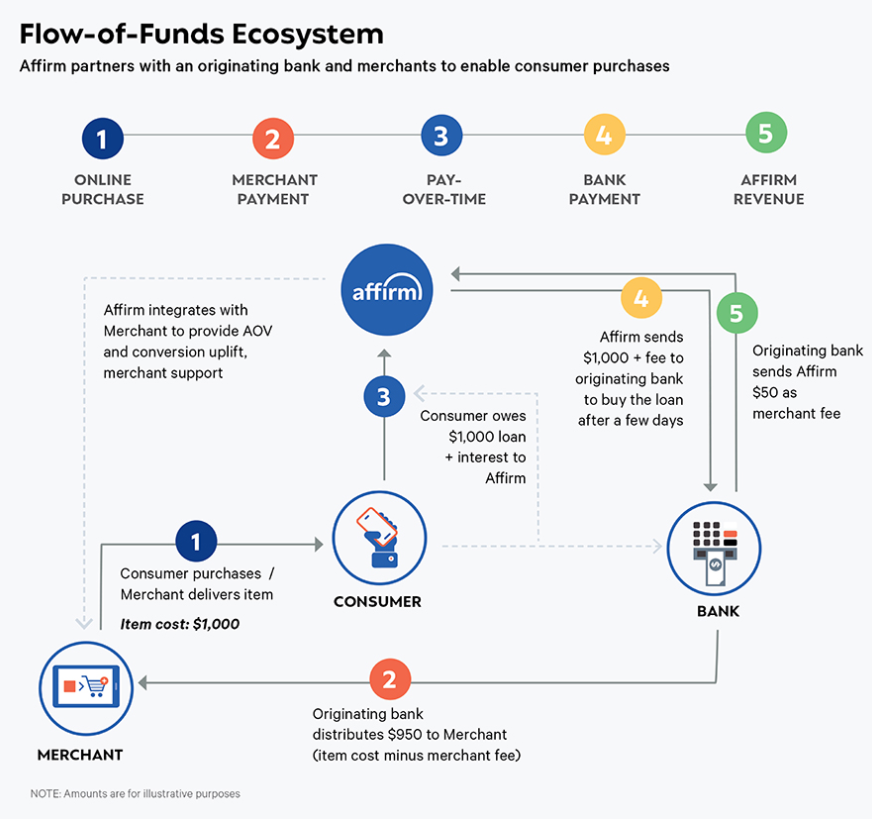
  2. Buy goat now, pay-later. 2020 saw the emergence of buy-now, pay-later (BNPL) vendors like Affirm, Klarna, and Afterpay. These companies typically offer zero-interest loans to consumers and get paid a 5% merchant fee for increasing purchases at e-commerce stores. The stores (like Peloton for example) increase sales and the consumers benefit from not having to pay a significant upfront payment. The other way these companies make money is by charging interest payments on specific types of purchases (likely where the merchant doesn’t want to give away a fee). These interest rates can be really, really high - averaging around 10-30% depending on the purchase. This is not a new concept and the idea of payday loans at predatorily high-interest rates has been around for over 30 years. Luckily, the purchases that these BNPL providers are financing tend to not be really high-value products, but it’s still concerning that some people are buying things without understanding the true value they will have to pay in interest. When Rick purchases a real goat, after killing three androids, he finances it, paying $3,000 upfront and entering into a three-year payment contract. Rick’s wife Iran is outraged at the cost of the goat: "‘What are the monthly payments on the goat?’ She held out her hand; reflexively he got out the contract which he had signed, passed it to her. ‘That much,’ she said in a thin voice. ‘The interest; good god — the interest alone. And you did this because you were depressed. Not as a surprise for me, as you originally said.” With BNPL providers now securitizing these consumer loans and selling them off to banks, I wonder if we will see any new regulation come to bear for the benefit of consumers. If people are not careful, they could be locked into long contracts with significant interest over time.

  3. Two case studies in electric animals. Electric animals have actually been invented and while they may not be the equivalent of Goddard from Jimmy Neutron yet, they are pretty funny and interesting case studies. Sony released the AIBO dog in 1999 after many years of research. The original robot dog cost $2,100 (~$3,500 in today’s dollars) and sold about 65,000 units. The programmable software allowed the dogs to be used in a variety of situations including an AI soccer world cup. The initial popularity of the dogs waned, and price wars with new rivals caused sales to decline. In 2006, the AIBO dog was discontinued. In 2018, it made a resurgence and is now a barking flexible model that you can pet, play games with, and feed. Another tale of odd mechanic animals is Boston Dynamics. The company that spun out of MIT in 1992 produced massive quadruped animals including one called BigDog, that was capable of balancing, walking up-hill, and carrying significant amounts of equipment. The Company had trouble selling products though and was acquired by Google in 2013 for an undisclosed sum. This came at a time when Google was pushing heavily into robotics with Google Glass and what would become Waymo - they literally titled this Project Replicant (the name used for Android in the Blade Runner film). After some more years of underperformance, Google sold Boston Dynamics to Softbank in 2017. After years of development, the company finally released a product to consumers for a whopping $75,000. The dog is still pretty creepy and comes without a real face, unlike the Aibo. In 2020, it was announced that Hyundai had acquired an 80% stake in the business at a $1.1B valuation. We are still years away from having electric animals that mimic real-life animals and that may be a good thing.

Dig Deeper

  • Blade Runner: How Its Problems Made It a Better Movie

  • Does Buy Now, Pay Later Threaten Credit Card Issuers?

  • Predicting a Future Where the Future Is Routinely Predicted

  • An Overview of the latest Affirm Consumer Loan Securitization

  • Snakes in a Facebook Data Center

tags: Alan Turing, Ghost in the Shell, Blade Runner, Philip K. Dick, Sony, AI, AGI, Google, Microsoft, Yahoo, BNPL, Affirm, Klarna, Afterpay, e-Commerce, Securitization, Jimmy Neutron, AIBO, Boston Dynamics, Softbank, Hyundai, Facebook, Waymo, Rick Deckard, Detroit: Become Human, Los Angeles, San Francisco
categories: Fiction
 

About Contact Us | Recommend a Book Disclaimer