• Tech Book of the Month
  • Archive
  • Recommend a Book
  • Choose The Next Book
  • Sign Up
  • About
  • Search
Tech Book of the Month
  • Tech Book of the Month
  • Archive
  • Recommend a Book
  • Choose The Next Book
  • Sign Up
  • About
  • Search

March 2020 - The Hard Thing About Hard Things by Ben Horowitz

Ben Horowitz, GP of the famous investment fund Andreessen Horowitz, addresses the not-so-pleasant aspects of being a founder/CEO during a crisis. This book provides an excellent framework for anyone going through the struggles of scaling a business and dealing with growing pains.

Tech Themes

  1. The importance of Netscape. Now that its been relegated to history by the rise of AOL and internet explorer, its hard to believe that Netscape was ever the best web browser. Founded by Marc Andreessen, who had founded the first web browser, Mosaic (as a teenager!), Netscape would go on to achieve amazing success only to blow up in the face of competition and changes to internet infrastructure. Netscape was an incredible technology company, and as Brian McCullough shows in last month’s TBOTM, Netscape was the posterchild for the internet bubble. But for all the fanfare around Netscape’s seminal IPO, little is discussed about its massive and longstanding technological contributions. In 1995, early engineer Brendan Eich created Javascript, which still stands as the dominant front end language for the web. In the same year, the Company developed Secure Socket Layer (SSL), the most dominant basic internet security protocol (and reason for HTTPS). On top of those two fundamental technologies, Netscape also developed the internet cookie, in 1994! Netscape is normally discussed as the amazing company that ushered many of the first internet users onto the web, but its rarely lauded for its longstanding technological contributions. Ben Horowitz, author of the Hard Thing About Hard Things was an early employee and head of the server business unit for Netscape when it went public.

  2. Executing a pivot. Famous pivots have become part of startup lore whether it be in product (Glitch (video game) —> Slack (chat)), business model (Netflix DVD rental —> Streaming), or some combo of both (Snowdevil (selling snowboards online) —> Shopify (ecommerce tech)). The pivot has been hailed as necessary tool in every entrepreneur’s toolbox. Though many are sensationalized, the pivot Ben Horowitz underwent at LoudCloud / Opsware is an underrated one. LoudCloud was a provider of web hosting services and managed services for enterprises. The Company raised a boatload ($346M) of money prior to going public in March 2001, after the internet bubble had already burst. The Company was losing a lot of money and Ben knew that the business was on its last legs. After executing a 400 person layoff, he sold the managed services part of the business to EDS, a large IT provider, for $63.5M. LoudCloud had a software tool called Opsware that it used to manage all of the complexities of the web hosting business, scaling infrastructure with demand and managing compliance in data centers. After the sale was executed, the company’s stock fell to $0.35 per share, even trading below cash, which meant the markets viewed the Company as already bankrupt. The acquisition did something very important for Ben and the Opsware team, it bought them time - the Company had enough cash on hand to execute until Q4 2001 when it had to be cash flow positive. To balance out these cash issues, Opsware purchased Tangram, Rendition Networks, and Creekpath, which were all software vendors that helped manage the software of data centers. This had two effects - slowing the burn (these were profitable companies), and building a substantial product offering for data center providers. Opsware started making sales and the stock price began to tick up, peaking the attention of strategic acquirers. Ultimately it came down to BMC Software and HP. BMC offered $13.25 per share, the Opsware board said $14, BMC countered with $13.50 and HP came in with a $14.25 offer, a 38% premium to the stock price and a total valuation of $1.6B, which the board could not refuse. The Company changed business model (services —> software), made acquisitions and successfully exited, amidst a terrible environment for tech companies post-internet bubble.

  3. The Demise of the Great HP. Hewlett-Packard was one of the first garage-borne, silicon valley technology companies. The company was founded in Palo Alto by Bill Hewlett and Dave Packard in 1939 as a provider of test and measurement instruments. Over the next 40 years, the company moved into producing some of the best printers, scanners, calculators, logic analyzers, and computers in the world. In the 90s, HP continued to grow its product lines in the computing space, and executed a spinout of its manufacturing / non-computing device business in 1999. 1999 marks the tragic beginning of the end for HP. The first massive mistake was the acquisition of Compaq, a flailing competitor in the personal computer market, who had acquired DEC (a losing microprocessor company), a few years earlier. The acquisition was heavily debated, with Walter Hewlett, son of the founder and board director at the time, engaging in a proxy battle with then current CEO, Carly Firorina. The new HP went on to lose half of its market value and incur heavy job losses that were highly publicized. This started a string of terrible acquisitions including EDS, 3COM, Palm Inc., and Autonomy for a combined $28.8B. The Company spun into two divisions - HP Inc. and HP Enterprise in 2015 and each had their own spinouts and mergers from there (Micro Focus and DXC Technology). Today, HP Inc. sells computers and printers, and HPE sells storage, networking and server technology. What can be made of this sad tale? HP suffered from a few things. First, poor long term direction - in hindsight their acquisitions look especially terrible as a repeat series of massive bets on technology that was already being phased out due to market pressures. Second, HP had horrible corporate governance during the late 90s and 2000s - board in-fighting over acquisitions, repeat CEO fiirings over cultural issues, chairman-CEO’s with no checks, and an inability to see the outright fraud in their Autonomy acquisition. Lastly, the Company saw acquisitions and divestitures as band-aids - new CEO entrants Carly Fiorina (from AT&T), Mark Hurd (from NCR), Leo Apotheker (from SAP), and Meg Whitman (from eBay) were focused on making an impact at HP which meant big acquisitions and strategic shifts. Almost none of these panned out, and the repeated ideal shifts took a toll on the organization as the best talent moved elswehere. Its sad to see what has happened at a once-great company.

Business Themes
51DydLyUcrL.jpg
MarcA_Cover.jpg
  1. Ill, not sick: going public at the end of the internet bubble. Going public is supposed to be the culmination of a long entrepreneurial journey for early company employees, but according to Ben Horowitz’s experience, going public during the internet bubble pop was terrible. Loudcloud had tried to raise money privately but struggled given the terrible conditions for raising money at the beginning of 2001. Its not included in the book but the reason the Company failed to raise money was its obscene valuation and loss. The Company was valued at $1.15B in its prior funding round and could only report $6M in Net Revenue on a $107M loss. The Company sought to go public at $10 per share ($700M valuation), but after an intense and brutal roadshow that left Horowitz physically sick, they settled for $6.00 per share, a massive write-down from the previous round. The fact that the banks were even able to find investors to take on this significant risk at this point in the business cycle was a marvel. Timing can be crucial in an IPO as we saw during the internet bubble; internet “businesses” could rise 4-5x on their first trading day because of the massive and silly web landgrab in the late 90s. On the flip side, going public when investors don’t want what you’re selling is almost a death sentence. Although they both have critical business and market issues, WeWork and Casper are clear examples of the importance of timing. WeWork and Casper were late arrivals on the unicorn IPO train. Let me be clear - both have huge issues (WeWork - fundamental business model, Casper - competition/differentiation) but I could imagine these types of companies going public during a favorable time period with a relatively strong IPO. Both companies had massive losses, and investors were especially wary of losses after the failed IPOs of Lyft and Uber, which were arguably the most famous unicorns to go public at the time. Its not to say that WeWork and Casper wouldn’t have had trouble in the public markets, but during the internet bubble these companies could’ve received massive valuations and raised tons of cash instead of seeking bailouts from Softbank and reticent public market investors.

  2. Peactime / Wartime CEO. The genesis of this book was a 2011 blog post written by Horowitz detailing Peacetime and Wartime CEO behavior. As the book and blog post describe, “Peacetime in business means those times when a company has a large advantage vs. the competition in its core market, and its market is growing. In times of peace, the company can focus on expanding the market and reinforcing the company’s strengths.” On the other hand, to describe Wartime, Horowitz uses the example of a previous TBOTM, Only the Paranoid Survive, by Andy Grove. In the early 1980’s, Grove realized his business was under serious threat as competition increased in Intel’s core business, computer memory. Grove shifted the entire organization whole-heartedly into chip manufacturing and saved the company. Horowitz outlines several opposing behaviors of Peacetime and Wartime CEOs: “Peacetime CEO knows that proper protocol leads to winning. Wartime CEO violates protocol in order to win; Peacetime CEO spends time defining the culture. Wartime CEO lets the war define the culture; Peacetime CEO strives for broad based buy in. Wartime CEO neither indulges consensus-building nor tolerates disagreements.” Horowitz concludes that executives can be a peacetime and wartime CEO after mastering each of the respective skill sets and knowing when to shift from peacetime to wartime and back. The theory is interesting to consider; at its best, it provides an excellent framework for managing times of stress (like right now with the Coronavirus). At its worst, it encourages poor CEO behavior and cut throat culture. While I do think its a helpful theory, I think its helpful to think of situations that may be an exception, as a way of testing the theory. For example, lets consider Google, as Horowitz does in his original article. He calls out that Google was likely entering in a period of wartime in 2011 and as a result transitioned CEOs away from peacetime Eric Schmidt to Google founder and wartime CEO, Larry Page. Looking back however, was it really clear that Google was entering wartime? The business continued to focus on what it was clearly best at, online search advertising, and rarely faced any competition. The Company was late to invest in cloud technology and many have criticized Google for pushing billions of dollars into incredibly unprofitable ventures because they are Larry and Sergey’s pet projects. In addition, its clear that control had been an issue for Larry all along - in 2011, it came out that Eric Schmidt’s ouster as CEO was due to a disagreement with Larry and Sergey over continuing to operate in China. On top of that, its argued that Larry and Sergey, who have controlling votes in Google, stayed on too long and hindered Sundar Pichai’s ability to effectively operate the now restructured Alphabet holding company. In short, was Google in a wartime from 2011-2019? I would argue no, it operated in its core market with virtually no competition and today most Google’s revenues come from its ad products. I think the peacetime / wartime designation is rarely so black and white, which is why it is so hard to recognize what period a Company may be in today.

  3. Firing people. The unfortunate reality of business is that not every hire works out, and that eventually people will be fired. The Hard Thing About Hard Things is all about making difficult decisions. It lays out a framework for thinking about and executing layoffs, which is something that’s rarely discussed in the startup ecosystem until it happens. Companies mess up layoffs all the time, just look at Bird who recently laid off staff via an impersonal Zoom call. Horowitz lays out a roughly six step process for enacting layoffs and gives the hard truths about executing the 400 person layoff at LoudCloud. Two of these steps stand out because they have been frequently violated at startups: Don’t Delay and Train Your Managers. Often times, the decision to fire someone can be a months long process, continually drawn out and interrupted by different excuses. Horowitz encourages CEOs to move thoughtfully and quickly to stem leaks of potential layoffs and to not let poor performers continue to hurt the organization. The book discusses the Law of Crappy People - any level of any organization will eventually converge to the worst person on that level; benchmarked against the crappiest person at the next level. Once a CEO has made her mind up about the decision to fire someone, she should go for it. As part of executing layoffs, CEOs should train their managers, and the managers should execute the layoffs. This gives employees the opportunity to seek direct feedback about what went well and what went poorly. This aspect of the book is incredibly important for all levels of entrepreneurs and provides a great starting place for CEOs.
Dig Deeper

  • Most drastic company pivots that worked out

  • Initial thoughts on the Opsware - HP Deal from 2007

  • A thorough history of HP’s ventures, spin-offs and acquisitions

  • Ben’s original blog post detailing the pivot from service provider to tech company

  • The First (1995-01) and Second Browser War (2004 - 2017)

tags: Apple, IBM, VC, Google, HP, Packard's Law, Amazon, Android, Internet History, Marc Andreessen, Andreessen Horowitz, Loudcloud, Opsware, BMC Software, Mark Hurd, Javascript, Shopify, Slack, Netflix, Compaq, DEC, Micro Focus, DXC Technology, Carly Firoina, Leo Apotheker, Meg Whitman, WeWork, Casper, Larry Page, Eric Schmidt, Sundar Pichai, batch2
categories: Non-Fiction
 

February 2020 - How the Internet Happened: From Netscape to the iPhone by Brian McCullough

Brian McCullough, host of the Internet History Podcast, does an excellent job of showing how the individuals adopted the internet and made it central to their lives. He follows not only the success stories but also the flame outs which provide an accurate history of a time of rapid technological change.

Tech Themes

  1. Form to Factor: Design in Mobile Devices. Apple has a long history with mobile computing, but a few hiccups in the early days are rarely addressed. These hiccups also telegraph something interesting about the technology industry as a whole - design and ease of use often trump features. In the early 90’s Apple created the Figaro, a tablet computer that weighed eight pounds and allowed for navigation through a stylus. The issue was it cost $8,000 to produce and was 3/4 of an inch thick, making it difficult to carry. In 1993, the Company launched the Newton MessagePad, which cost $699 and included a calendar, address book, to-do list and note pad. However, the form was incorrect again; the MessagePad was 7.24 in. x 4.5 in. and clunky. With this failure, Apple turned its attention away from mobile, allowing other players like RIM and Blackberry to gain leading market share. Blackberry pioneered the idea of a full keyboard on a small device and Marc Benioff, CEO of salesforce.com, even called it, “the heroin of mobile computing. I am serious. I had to stop.” IBM also tried its hand in mobile in 1992, creating the Simon Personal Communicator, which had the ability to send and receive calls, do email and fax, and sync with work files via an adapter. The issue was the design - 8 in. by 2.5 in. by 1.5 in. thick. It was a modern smartphone, but it was too big, clunky, and difficult to use. It wasn’t until the iPhone and then Android that someone really nailed the full smart phone experience. The lessons from this case study offer a unique insight into the future of VR. The company able to offer the correct form factor, at a reasonable price can gain market share quickly. Others who try to pioneer too much at a time (cough, magic leap), will struggle.

  2. How to know you’re onto something. Facebook didn’t know. On November 30, 2004, Facebook surpassed one million users after being live for only ten months. This incredible growth was truly remarkable, but Mark Zuckerberg still didn’t know facebook was a special company. Sean Parker, the founder of Napster, had been mentoring Zuckerberg the prior summer: “What was so bizarre about the way Facebook was unfolding at that point, is that Mark just didn’t totally believe in it and wanted to go and do all these other things.” Zuckerberg even showed up to a meeting at Sequoia Capital still dressed in his pajamas with a powerpoint entitled: “The Top Ten Reasons You Should Not Invest.” While this was partially a joke because Sequoia has spurned investing in Parker’s latest company, it represented how immature the whole facebook operation was, in the face of rapid growth. Facebook went on to release key features like groups, photos, and friending, but most importantly, they developed their revenue model: advertising. The quick user growth and increasing ad revenue growth got the attention of big corporations - Viacom offered $2B in cash and stock, and Yahoo offered $1B all cash. By this time, Zuckerberg realized what he had, and famously spurned several offers from Yahoo, even after users reacted negatively to the most important feature that facebook would ever release, the News Feed. In today’s world, we often see entrepreneur’s overhyping their companies, which is why Silicon Valley was in-love with dropout founders for a time, their naivite and creativity could be harnessed to create something huge in a short amount of time.

  3. Channel Partnerships: Why apple was reluctant to launch a phone. Channel partnerships often go un-discussed at startups, but they can be incredibly useful in growing distribution. Some industries, such as the Endpoint Detection and Response (EDR) market thrives on channel partnership arrangements. Companies like Crowdstrike engage partners (mostly IT services firms) to sell on their behalf, lowering Crowdstrike’s customer acquisition and sales spend. This can lead to attractive unit economics, but on the flip side, partners must get paid and educated on the selling motion which takes time and money. Other channel relationships are just overly complex. In the mid 2000’s, mobile computing was a complicated industry, and companies hated dealing with old, legacy carriers and simple clunky handset providers. Apple tried the approach of working with a handset provider, Motorola, but they produced the terrible ROKR which barely worked. The ROKR was built to run on the struggling Cingular (would become AT&T) network, who was eager to do a deal with Apple in hopes of boosting usage on their network. After the failure of the ROKR, Cingular executives begged Jobs to build a phone for the network. Normally, the carriers had specifications for how phones were built for their networks, but Jobs ironed out a contract which exchanged network exclusivity for complete design control, thus Apple entered into mobile phones. The most important computing device of the 2000’s and 2010’s was built on a channel relationship.

Business Themes

caseaoltimewarner.jpg
timewarner_aol_facts1.jpg
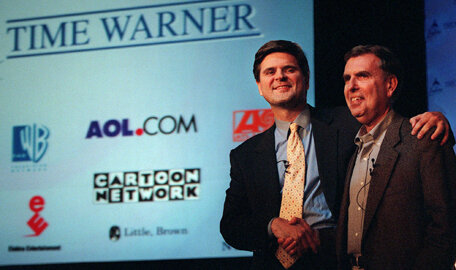
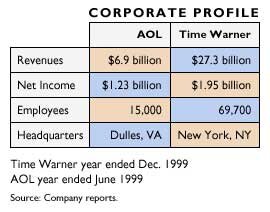
  1. AOL-Time Warner: the merger destined to fail. To fully understand the AOL-Time Warner merger, you must first understand what AOL was, what it was becoming, and why it was operating on borrowed time. AOL started as an ISP, charging customers $9.95 for five hours of dial-up internet access, with each additional hour costing $2.95. McCullough describes AOL: “AOL has often been described as training wheels for the Internet. For millions of Americans, their aol.com address was their first experience with email, and thus their first introduction to the myriad ways that networked computing could change their lives.” AOL grew through one of the first viral marketing campaigns ever; AOL put CDs into newspapers which allowed users to download AOL software and get online. The Company went public in March of 1992 and by 1996 the Company had 2.1 million subscribers, however subscribers were starting to flee to cheaper internet access. It turned out that building an ISP was relatively cheap, and the high margin cash flow business that AOL had built was suddenly threatened by a number of competitors. AOL persisted with its viral marketing strategy, and luckily many americans still had not tried the internet yet and defaulted to AOL as being the most popular. AOL continued to add subscribers and its stock price started to balloon; in 1998 alone the stock went up 593%. AOL was also inking ridiculous, heavily VC funded deals with new internet startups. Newly public Drkoop, which raised $85M in an IPO, signed a four year $89M deal to be AOL’s default provider of health content. Barnes and Noble paid $40M to be AOL’s bookselling partner. Tel-save, a long distance phone provider signed a deal worth $100M. As the internet bubble continued to grow, AOL’s CEO, Steve Case realized that many of these new startups would be unable to fufill their contractual obligations. Early web traffic reporting systems could easily be gamed, and companies frequently had no business model other than attract a certain demographic of traffic. By 1999, AOL had a market cap of $149.8B and was added to the S&P 500 index; it was bigger than both Disney and IBM. At this time, the world was shifting away from dial-up internet to modern broadband connections provided by cable companies. One AOL executive lamented: “We all knew we were living on borrowed time and had to buy something of substance by using that huge currency [AOL’s stock].” Time Warner was a massive media company, with movie studios, TV channels, magazines and online properties. On Jan 10, 2000, AOL merged with Time Warner in one of the biggest mergers in history. AOL owned 56% of the combined company. Four days later, the Dow peaked and began a downturn which would decimate hundreds of internet businesses built on foggy fundamentals. Acquisitions happen for a number of reasons, but imminent death is not normally considered by analysts or pundits. When you see acquisitions, read the press release and understand why (at least from a marketing perspective), the two companies made a deal. Was the price just astronomical (i.e. Instagram) or was their something very strategic (i.e. Microsoft-Github)? When you read the press release years later, it should indicate whether the combination actually was proved out by the market.

  2. Acquisitions in the internet bubble: why acquisitions are really just guessing. AOL-Time Warner shows the interesting conundrum in acquisitions. HP founder David Packard coined this idea somewhat in Packard’s law: “No company can consistently grow revenues faster than its ability to get enough of the right people to implement that growth and still become a great company. If a company consistently grows revenue faster than its ability to get enough of the right people to implement that growth, it will not simply stagnate; it will fall.” Author of Good to Great, Jim Collins, clarified this idea: “Great companies are more likely to die of ingestion of too much opportunity, than starvation from too little.” Acquisitions can be a significant cause of this outpacing of growth. Look no further than Yahoo, who acquired twelve companies between September 1997 and June 1999 including Mark Cuban’s Broadcast.com for $5.7B (Kara Swisher at WSJ in 1999), GeoCities for $3.6B, and Y Combinator founder Paul Graham’s Viaweb for $48M. They spent billions in stock and cash to acquire these companies! Its only fitting that two internet darlings would eventually end up in the hands of big-telecom Verizon, who would acquire AOL for $4.4B in 2015, and Yahoo for $4.5B in 2017, only to write down the combined value by $4.6B in 2018. In 2013, Yahoo would acquire Tumblr for $1.1B, only to sell it off this past year for $3M. Acquisitions can really be overwhelming for companies, and frequently they don’t work out as planned. In essence, acquisitions are guesses about future value to customers and rarely are they as clean and smart as technology executives make them seem. Some large organizations have gotten good at acquisitions - Google, Microsoft, Cisco, and Salesforce have all made meaningful acquisitions (Android, Github, AppDynamics, ExactTarget, respectively).

  3. Google and Excite: the acquisition that never happened. McCullough has an incredible quote nestled into the start of chapter six: “Pioneers of new technologies are rarely the ones who survive long enough to dominate their categories; often it is the copycat or follow-on names that are still with us to this day: Google, not AltaVista, in search; Facebook, not Friendster, in social networks.” Amazon obviously bucked this trend (he mentions that), but in search he is absolutely right! In 1996, several internet search companies went public including Excite, Lycos, Infoseek, and Yahoo. As the internet bubble grew bigger, Yahoo was the darling of the day, and by 1998, it had amassed a $100B market cap. There were tons of companies in the market including the players mentioned above and AltaVista, AskJeeves, MSN, and others. The world did not need another search engine. However, in 1998, Google founders Larry Page and Sergey Brin found a better way to do search (the PageRank algorithm) and published their famous paper: “The Anatomy of a Large-Scale Hypertextual Web Search Engine.” They then went out to these massive search engines and tried to license their technology, but no one was interested. Imagine passing on Goolge’s search engine technology. In an over-ingestion of too much opportunity, all of the search engines were trying to be like AOL and become a portal to the internet, providing various services from their homepages. From an interview in 1998, “More than a "portal" (the term analysts employ to describe Yahoo! and its rivals, which are most users' gateway to the rest of the Internet), Yahoo! is looking increasingly like an online service--like America Online (AOL) or even CompuServe before the Web.” Small companies trying to do too much (cough, uber self-driving cars, cough). Excite showed the most interest in Google’s technology and Page offered it to the Company for $1.6M in cash and stock but Excite countered at $750,000. Excite had honest interest in the technology and a deal was still on the table until it became clear that Larry wanted Excite to rip out its search technology and use Google’s instead. Unfortunately that was too big of a risk for the mature Excite company. The two companies parted ways and Google eventually became the dominant player in the industry. Google’s focus was clear from the get-go, build a great search engine. Only when it was big enough did it plunge into acquisitions and development of adjacent technologies.

Dig Deeper

  • Raymond Smith, former CEO of Bell Atlantic, describing the technology behind the internet in 1994

  • Bill Gates’ famous memo: THE INTERNET TIDAL WAVE (May 26, 1995)

  • The rise and fall of Netscape and Mosaic in one chart

  • List of all the companies made famous and infamous in the dot-com bubble

  • Pets.com S-1 (filing for IPO) showin a $62M net loss on $6M in revenue

  • Detail on Microsoft’s antitrust lawsuit

tags: Apple, IBM, Facebook, AT&T, Blackberry, Sequoia, VC, Sean Parker, Yahoo, Excite, Netscape, AOL, Time Warner, Google, Viaweb, Mark Cuban, HP, Packard's Law, Disney, Steve Case, Steve Jobs, Amazon, Drkoop, Android, Mark Zuckerberg, Crowdstrike, Motorola, Viacom, Napster, Salesforce, Marc Benioff, Internet, Internet History, batch2
categories: Non-Fiction
 

January 2020 - The Innovators by Walter Isaacson

Isaacson presents a comprehensive history of modern day technology, from Ada Lovelace to Larry Page. He weaves in intricate detail around the development of the computer, which provides the landscape on which all the major players of technological history wander.

Tech Themes

  1. Computing Before the Computer. In the Summer of 1843, Ada Lovelace, daughter of the poet Lord Byron, wrote the first computer program, detailing a way of repeatedly computing Bernoulli numbers. Lovelace had been working with Charles Babbage, an English mathematician who had conceived of an Analytical Engine, which could be used as a general purpose arithmetic logic unit. Originally, Babbage thought his machine would only be used for computing complex mathematical problems, but Ada had a bigger vision. Ada was well educated and artistic like her father. She knew that the general purpose focus of the Analytical Engine could be an incredible new technology, even hypothesizing, “Supposing, for instance, that the fundamental relations, of pitched sounds in the science of harmony and musical composition were susceptible to such expression and adaptations, the engine might compose elaborate and scientific pieces of music of any degree of complexity.” 176 years later, in 2019, OpenAI released a deep neural network that produces 4 minute musical compositions, with ten different instruments.

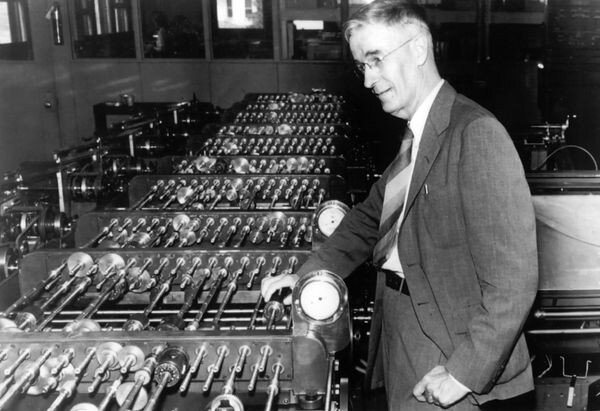
    2. The Government, Education and Technology. Babbage had suggested using punch cards for computers, but Herman Hollerith, an employee of the U.S. Census Bureau, was the first to successfully implement them. Hollerith was angered that the decennial census took eight years to successfully complete. With his new punch cards, designed to analyze combinations of traits, it took only eight. In 1924, after a series of mergers, the company Hollerith founded became IBM. This was the first involvement of the US government with computers. Next came educational institutions, namely MIT, where by 1931 Vanneaver Bush had built a Differential Analyzer (pictured below), the world’s first analog electric computing machine. This machine would be copied by the U.S. Army, University of Pennsylvania, Manchester University and Cambridge University and iterated on until the creation of the Electronic Numerical Integrator and Computer (ENIAC), which firmly established a digital future for computing machines. With World War as a motivator, the invention of the computer was driven forward by academic institutions and the government.

Business Themes

102680080-03-01.jpg
  1. Massive Technological Change is Slow. Large technological change almost always feels sudden, but it rarely ever is. Often, new technological developments are relegated to small communities, like Homebrew computing club, where Steve Wozniak handed out mock-ups for the Apple Computer, which was the first to map a keyboard to a screen for input. The development of the transistor (1947) preceded the creation of the microchip (1958) by eleven years. The general purpose chip, a.k.a. the microprocessor popped up thirteen years after that (1971), when Intel introduced the 4004 into the business world. This phenomenon was also true with the internet. Packet switching was first discovered in the early 1960s by Paul Baran, while he was at the RAND Corporation. The Transmission Control Protocol and Internet Protocol were created fifteen years after that (1974) by Vint Cerf and Bob Kahn. The HyperText Transfer Protocol (HTTP) and the HyperText Markup Language (HTML) were created sixteen years after that in 1990 by Tim Berners-Lee. The internet wasn’t in widespread use until after 2000. Introductions of new technologies often seem sudden, but they frequently call on technologies of the past and often involve a corresponding change that address the prior limiting factor of a previous technology. What does that mean for cloud computing, containers, and blockchain? We are probably earlier in the innovation cycle than we can imagine today. Business does not always lag the innovation cycle, but is normally the ending point in a series of innovations.

  2. Teams are Everything. Revolution and change happens through the iteration of ideas through collaborative processes. History provides a lot of interesting lessons when it comes to technology transformation. Teams with diverse backgrounds, complementary styles and a mix of visionary and operating capabilities executed the best. As Isaacson notes: “Bell Labs was a classic example. In its long corridors in suburban New Jersey, there were theoretical physicists, experimentalists, material scientists, engineers, a few businessmen, and even some telephone pole climbers with grease under their fingernails.” Bell Labs created the first transistor, a semiconductor that would be the foundation of Intel’s chips, where Bob Noyce and Gordon Moore (yes – Moore’s Law) would provide the vision, and Andy Grove would provide the focus.

Dig Deeper

  • Alan Turing and the Turing Machine

  • The Deal that Ruined IBM and Catapulted Microsoft

  • Grace Hopper and the First Compiler

  • ARPANET and the Birth of the Internet

tags: IBM, Microsoft, Moore's Law, Apple, Alan Turing, OpenAI, Cloud Computing, Bell Labs, Intel, MIT, Ada Lovelace, batch2
categories: Non-Fiction
 

November 2019 - Brotopia: Breaking Up the Boys' Club of Silicon Valley by Emily Chang

This book details a number of factors that have discouraged women’s participation and promotion in the tech industry. Emily Chang gives a brief history of the circumstances that have pushed women away from the industry and then covers its current issues - weaving in great insights and actionable takeaways along the way.

Tech Themes

  1. The Antisocial Programmer. As the necessity for technological talent began to rise in the early 1960s, many existing companies were unsure how to hire the right people. To address this shortfall in know-how, companies used standard aptitude tests, like IBM’s Programmer Aptitude Test, to examine whether a candidate was capable of applying the right problem solving skills on the job. Beyond these standard aptitude tests, companies leveraged personality exams. In 1966, a large software company called System Development Corporation hired William Cannon and Dallis Perry to build a personality test that could shed light on the right personalities needed on the job. To build this personality test, Cannon and Perry profiled 1,378 programmers on a range of personality traits. Of those 1,378 profiled, only 186 were women. After compiling their findings, the final report stated: “[Programmers] dislike activities involving close personal interaction; they are generally more interested in things than people.” Furthermore, Cannon and Perry’s 82-page paper made no reference to women at all, referring to the surveyed group as men, for the entire paper. A combination of aptitude tests and Cannon-Perry’s personality test became the industry standard for recruiting, and soon companies were mistakenly focused on stereotypical antisocial programmers. Antisocial personality disorder is three times more common in men than women. Given how early the tech industry was, compared to what it is now, this decision to hire a majority of anti-social men has propagated throughout the industry, with senior leaders continually reinforcing incorrect hiring standards.

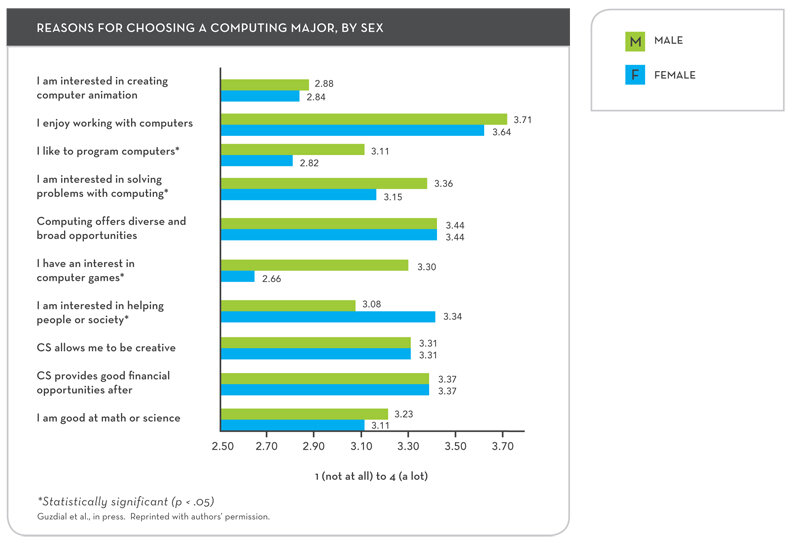
  2. Women in Computer Science. According to the book, “there was an overall peak in bachelor’s degrees awarded in computer science in the mid-1980s, and a peak in the percentage of women receiving those degrees at nearly 40 percent. And then there was a steep decline in both.” It was at this time in the mid-1980s that computer science departments began to turn away anyone who was not a pre-qualified, academic top performer. There was too much demand with a constrained supply of qualified teachers, so only the best kids were allowed into top programs. This caused students to view computer science as hyper-competitive and unwelcoming to individuals without significant experience. Today, women earn only 18% of computer science degrees – a statistic that shocks many in the industry. Researchers at NPR found that intro CS courses play a key role in this problem – with many teachers still assuming students have prior familiarity with coding. Furthermore, women are socialized in a number of ways to achieve perfection, so when brand new code is not working well, women are more likely to feel discouraged. It is imperative to encourage women to try computer science if they have interest, to combat these negative trends.

  3. PayPal and Perpetuating Cycles. After the dot-com bubble burst in the early 2000s, several newly minted millionaires did the natural thing after selling a company for millions of dollars, became a venture capitalists. One of the major success stories of the era was PayPal. Among those newly minted millionaires were the PayPal mafia: Peter Thiel, Keith Rabois, Elon Musk, Max Levchin, David Sacks, and Reid Hoffman. Thiel and Rabois have a history of suggesting a meritocratic process of hiring where only the most qualified academic candidate should land the job, not taking into account diversity of any form. Furthermore, in his book Zero to One (which we’ve discussed before), Thiel proposes startups should hire only “nerds of the same type.” The mafia began investing in several new companies, seeding friends who were likely to perpetuate the cycle of recruiting friends and hiring based on status alone. Rabois, who is currently a venture capitalist has remarked: “Once you have alignment, then I think you can have a wide swath of people, views and perspectives.” These ideas seem more like justification for hiring large groups of white males who were friends of PayPal executives than a truly “meritocratic” process, which is not the best way of building a successful, diverse organization. Roger McNamee, founder of technology private equity firm, Silver Lake, suggests: “They didn’t just perpetuate it; they turned it into a fine art. They legitimized it… The guys were born into the right part of the gene pool, they wind up at the right company, at the right moment in time, they all leave together and [go on] to work together. I give them full credit for it but calling it a meritocracy is laughable.”

Business Themes

chartoftheday_4467_female_employees_at_tech_companies_n.jpg
reasons_for_choosing_a_computing_major_by_sex.jpg
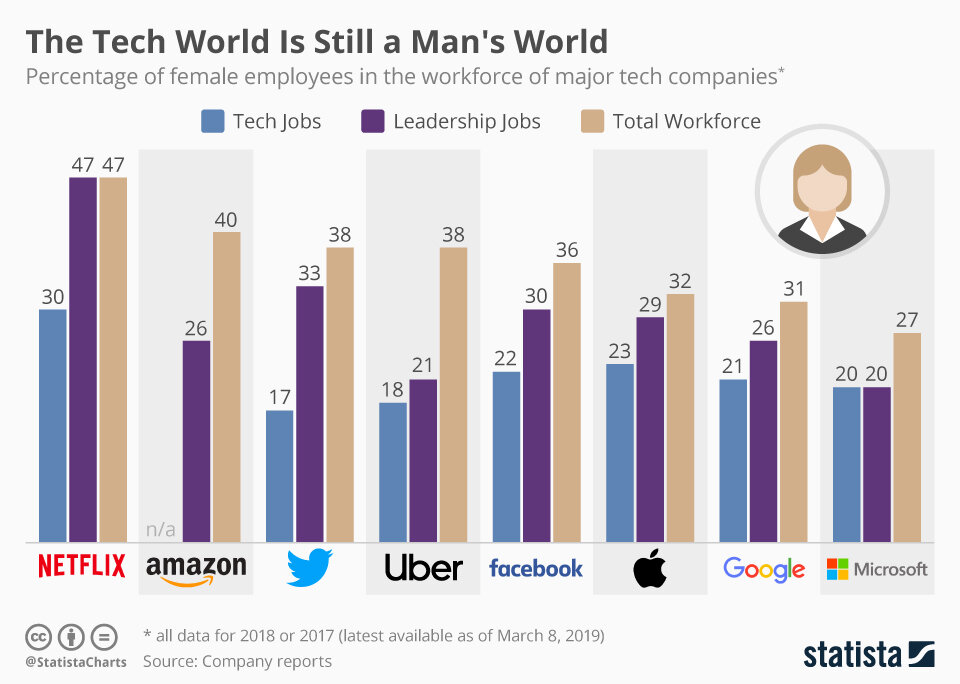
  1. The Women at Early Google. A lot of people know the story of Sergey Brin meeting co-founder Larry Page. But few are aware of when Sergey and Larry met Susan Wojcicki, who is now CEO of YouTube. Sergey and Larry were looking for office space, and through a mutual friend, were introduced to Susan Wojcicki, who worked in marketing at Intel at the time. Though she didn’t jump on board immediately, Susan eventually came around and was instrumental in launching two of Google’s most important products: AdWords and AdSense. Wojcicki would soon be working closely with a newly recruited, Marissa Mayer, who after graduating from Stanford with a degree in Symbolic Systems, joined Google to help build AdWords and design Google’s front-end. Wojcicki and Mayer would soon be joined by Sheryl Sandberg, who came to Google in 2001 as Vice President of Online Sales and Operations. Another now-famous early female employee was Kim Scott, author of Radical Candor, who joined the company in 2004. All of these early, powerful female leaders, with the continued urging of Larry and Sergey (who wanted to achieve a 50/50 ratio of male to female employees) helped build a strong culture of female leadership. But as the Company scaled it lost sight of its gender diversity goals – “In 2017, women accounted for 31% of employees overall, 25% of leadership roles and 20% of technical roles.” Google claims it lost touch as it scaled, when the need for hiring outpaced the ability to find qualified and diverse candidates – but that sounds like an easy cop out.

  2. Startups and Party Culture. Atari and Trilogy Software pioneered the idea of a work-hard, play-hard startup cultures. Nolan Bushnell of Atari would throw wild parties and have employees (including Steve Jobs) work late into the night, building for the company. Trilogy, a provider of sales and marketing software, extended this idea even further. It started with hiring, where, according to a former engineer, Trilogy’s ethos was: “We’re elite talent. It’s potential and talent, not experience, that has merit.” The Company regularly used complicated brain-teasers in interviews and attracted swaths of anti-social engineers with young and attractive talent recruiters. Joe Liemandt, the CEO of Trilogy, also moved the company to Austin, Texas; executives likened the tactic to marooning members of a cult. Co-founder Christy Jones remarked: “I didn’t go on vacation. We called holidays competitive advantage days because no one else was working. It was a chance to get ahead.” The Company had a strong drinking and partying culture and bares striking cult-like resemblance to WeWork, except it had a sustainable business model. Other technology companies have mixed constant alcohol and long hours, which has led to numerous assault charges at well-known startups including Uber, Zenefits, WeWork and others. Startup and party culture does not need to be so intertwined.

  3. Hiring Practices to Encourage Diverse Backgrounds. Stewart Butterfield, the founder of Flickr (sold to Yahoo for $20 million in 2005), has focused on diverse hiring efforts at his new company Slack. According to Brotopia, “In 2017, Slack reported that 43.5% of its employees were women, including 48% of managers and almost 30% of technical employees – far better numbers than any tech company in Silicon Valley.” Butterfield, who grew up on a commune in Canada, recognizes his privilege, and discusses its not insanely difficult to create a diverse environment: “As an already successful, white, male, straight – go down the list – I’m not going to have the relevant experience to determine what makes this a good workplace, so some of that is just being open but really just making it an explicit focus.” Slack’s diverse recruiting team was given explicit instructions to source candidates from underrepresented backgrounds and schools for every new role in the organization. More companies should follow Slack’s lead and adopt explicit gender and diversity goals.

Dig Deeper

  • Susan Fowler’s blog post describing terrible conditions at Uber

  • Overview of gender and diversity statistics of major technology companies

  • The Sex and Drug fueled parties of Silicon Valley VCs

  • A recap of the Google Walkout over sexual harassment allegations

  • The Tech Industry’s diversity is not improving

tags: Investing, Yahoo, Cloud Computing, Google, Facebook, Sheryl Sandberg, Susan Wojcicki, Marissa Mayer, IBM, Trilogy Software, Paypal, Peter Thiel, Keith Rabois, Zero to One, Silver Lake, Sergey Brin, Larry Page, YouTube, AdWords, AdSense, Atari, Nolan Bushnell, Steve Jobs, WeWork, Uber, Zenefits, Slack, Flickr, Stewart Butterfield, batch2
categories: Non-Fiction
 

October 2019 - The Design of Everyday Things by Don Norman

Psychologist Don Norman takes us through an exploratory journey of the basics in functional design. As the consumerization of software grows, this book’s key principles will become increasingly important.

Tech Themes

  1. Discoverability and Understanding. Discoverability and Understanding are two of the most key principles in design. Discoverability answers the questions of, “Is it possible to figure out what actions are possible and where and how to perform them?” Discoverability is absolutely crucial for first time application users because poor discovery of actions leads to low likelihood of repeat use. In terms of Discoverability, Scott Berkun notes that designers should prioritize what can be discovered easily: “Things that most people do, most often, should be prioritized first. Things that some people do, somewhat often, should come second. Things that few people do, infrequently, should come last.” Understanding answers the questions of: “What does it all mean? How is the product supposed to be used? What do all the different controls and settings mean?” We have all seen and used applications where features and complications dominate the settings and layout of the app. Understanding is simply about allowing the user to make sense of what is going on in the application. Together, Discoverability and Understanding lay the ground work for successful task completion before a user is familiar with an application.

  2. Affordances, Signifiers and Mappings. Affordances represent the set of possible actions that are possible; signifiers communicate the correct action that should take place. If we think about a door, depending on the design, possible affordances could be: push, slide, pull, twist the knob, etc. Signifiers represent the correct action or the action the designer would like you to perform. In the context of a door, a signifier might be a metal plate that makes it obvious that the door must be pushed. Mappings provide straightforward correspondence between two sets of objects. For example, when setting the brightness on an iPhone, swiping up increases brightness and swiping down decreases brightness, as would be expected by a new user. Design issues occur when there is a mismatch in affordances, signifiers and mappings. Doors provide another great example of poor coordination between affordances, signifiers and mappings - everyone has encountered a door with a handle that says push over it. This normally followed by an uncomfortable pushing and pulling motion to discover the actions possible with the door. Why are there handles if I am supposed to push? Good design and alignment between affordances, signifiers and mappings make life easier for everyone.

  3. The Seven Stages of Action. Norman lay outs the psychology underpinning user decisions in seven stages - Goal, Plan, Specify, Perform, Perceive, Interpret, Compare. The first three (Goal, Plan, Specify) represent the clarification of an action to be taken on the World. Once the action is Performed, the final three steps (Perceive, Interpret, Compare) are trying to make sense of the new state of the World. The seven stages of action help generalize the typical user’s interactions with the World. With these stages in mind, designers can understand potential breakdowns in discoverability, understanding, affordances, signifiers, and mappings. As users perform actions within applications, understanding each part of the customer journey allows designers to prioritize feature development and discoverability.

Business Themes

Normans-seven-stages-of-action-Redrawn-from-Norman-2001.png
  1. The best product does not always win, but... If the best product always won out, large entrenched incumbents across the software ecosystem like IBM, Microsoft, Google, SAP, and Oracle would be much smaller companies. Why are there so many large behemoths that won’t fall? Each company has made deliberate design decisions to reduce the amount of customer churn. While most of the large enterprise software providers suffer from Feature Creep, the product and deployment complexity can often be a deterrent to churn. For example, Enterprise CIOs do not want to spend budget to re-platform from AWS to Azure, unless there was a major incident or continued frustration with ease of use. Interestingly enough though, as we’ve discussed, the transition from license-maintenance software to SaaS, as well as the consumerization of the enterprise, are changing the necessity of good design and user experience. If we look at Oracle for example. The business has made several acquisitions of applications to be built on Oracle Databases. But the poor user experience and complexity of the applications is starting to push Oracle out of businesses.

  2. Shipping products on time and on budget. “The day a product development process starts, it is behind schedule and above budget.” The product design process is often long and complex because there is a wide array of disciplines involved in the process. Each discipline thinks they are the most important part of the process and may have different reasons for including a singular feature, which may conflict with good design. To alleviate some of that complexity, Norman suggests hiring design researchers that are separate from the product development focus. These researchers focus on how users are working in the field and are coming up with additional use cases / designs all the time. When the development process kicks off, target features and functionality have already been suggested.

  3. Why should business leaders care about good design? We have already discussed how product design can act as a deterrent to churn. If processes and applications become integral to Company function, then there is a low chance of churn, unless there is continued frustration with ease of use. Measuring product market fit is difficult but from a metrics perspective; companies can look at gross churn ($ or customer amount that left / beginning ARR or beginning customers) or NPS to judge how well their product is being received. Good design is a direct contributor to improved NPS and better retention. When you complement good design with several hooks into the customers, churn reduces.

Dig Deeper

  • UX Fundamentals from General Assembly

  • Why game design is crucial for preventing churn

  • Figma and InVision - the latest product development tools

  • Examples of bad user experience design

  • Introduction to Software Usage Analytics

tags: Internet, UX, UI, Design, Apple, App Store, AWS, Azure, Amazon, Microsoft, Oracle, batch2
categories: Non-Fiction
 

August 2019 - How Google Works by Eric Schmidt and Jonathan Rosenberg

While at times it reads as a piece of Google propaganda, this book offers insight into the management techniques that Larry, Sergey and Eric employed to grow the Company to massive scale. Its hard to read this book and expect that all of these practices were actually implemented – it reads like a “How to build a utopia work culture” - but some of the principles are interesting, and more importantly it gives us insight into what Google values in their products and operations.

Tech Themes

  1. Smart Creatives. Perhaps the most important emphasis in the book is placed on the recruiting and hiring of what Eric Schmidt and Jonathan Rosenberg have termed: Smart Creatives – “people who combine technical & business knowledge, creativity and always-learning attitude.” While these seem like the desired platitudes of every silicon valley employee, it gives a window into what Google finds important in its employees. For example, unlike Amazon, which has both business product managers and technical product managers, Google prefers its PMs to be both business focused and highly technical. Smart Creatives are mentioned hundreds of times in the book and continually underpin the success of new product launches. The book almost harps on it too much, to the point where it feels like Eric Schmidt was trying to convince all Googlers that they were truly unique.

  2. Meetings, Q&A, Data and Information Management. Google is one of the many Silicon Valley companies that hosts company wide all-hands Q&A sessions on Friday where anyone can ask a question of Google’s leadership. Information transparency is critically important to Google, and they try to allow data to be accessible throughout the organization at all times. This trickles into other aspects of Google’s management philosophy including meetings and information management. At Google, meetings have a single owner, and while laptops largely remain closed, it’s the owner’s job to present the relevant data and derive the correct insights for the team. To that end, Google makes its information transparently available for all to access – this process is designed to avoid information asymmetry at management levels. One key issue faced by poor management teams is only receiving the best information at the top – this is countered by Amazon through incredibly blunt and aggressive communication; Google, on the other hand, maintains its intense focus on data and results to direct product strategy, so much so that it even studies its own teams productivity using internal data. Google’s laser focus on data makes sense given its main advertising products harvest the world’s internet user data for their benefit, so understanding how to leverage data is always a priority at Google.

  3. 80/20 Time. As part of Google’s product innovation strategy, employees can spend 20% of their work time on creative projects separate from their current role. While the idea sounds like an awesome to keep employees interested and motivated, in practice, its much more structured. Ideas have to be approved by managers and they are only allowed if they can directly impact Google’s business. Some great innovations were spawned out of this policy including Gmail and Google Maps but Google employees have joked that it should be called “120%” time rather than 80%.

Business Themes

  1. Google’s Cloud Strategy. “You should spend 80% of your time on 80% of your revenue.” This quote speaks volumes when it comes to Google’s business strategy. Google clearly is the leader in Search and search advertising. Not only is it the default search engine preferred by most users, it also owns the browser market that directs searches to Google, and the most used operating system. It has certainly created a dominant position in the market and even done illegal things to maintain that advantage. Google also maintains and mines your data, and as Stratechery has pointed out, they are not hiding it anywhere. But what happens when the next wave of computing comes, and you are so focused on your core business that you end up light years behind competition from Amazon (Web Services) and Microsoft (Azure)? That’s where Google finds itself today, and recent outages and issues haven’t helped. So what is Google’s “Cloud Strategy?” The answer is lower priced, open source alternatives. Google famously developed and open sourced, Kubernetes, the container orchestration platform, which has become an increasingly important technology as developers opt for light weight alternatives to traditional virtual machines. They have followed this open sourcing with a, “We are going to open source everything” mentality that is also being employed, a bit more defensively at Microsoft. Google seeks to be an open source layer, either through Kubernetes (which runs in Azure and AWS) or through other open source platforms (Anthos) and just touch some of your company’s low churn cloud spend. Their issue is scale and support. With their knowledge of data centers and parallel computing, cloud capabilities seemed like an obvious place where Google could win, but they fumbled on building a great product because they were so focused on protecting their core business. They are in a catch up position and new CEO of Google Cloud, Thomas Kurian (formerly at Oracle), isn’t afraid to make acquisitions to build out missing product capabilities, which is why it bought Looker earlier this year. It makes sense why a company as focused as Google is on data, would want a cloud focused data analysis tool. Now they are betting on M&A and a highly open-sourced multi-public cloud future as the only way they can win.

  2. “Objective” Key Results. As mentioned previously, the way Google combats potential information asymmetries by empowering individuals throughout the organization with data. This extends to famous venture capitalist (who invested in both Google and Amazon) John Doerr’s favorite data to examine – OKRs – Objective key results. Each Googler has a specific set of OKRs that they are responsible for maintaining on a quarterly basis. Every person’s OKRs are readily available for anyone to see throughout the Company i.e. full transparency. OKRs are public, measurable, and ambitious. This keeps engineers focused and accountable, as long as the OKRs are set correctly and actually measure outcomes. These fit so perfectly with Google’s focus on mining and monitoring data at all times: their products and their employees need to be data driven at all times.

Dig Deeper

  • Recent reports highlight numerous cultural issues at Google, that are not addressed in the book

  • Google Cloud was plagued by internal clashes and missed acquisitions

  • PayPal mafia veteran, Keith Rabois, won’t fund Google PM’s as founders

  • List of Google’s biggest product failures over time

  • Stadia: Google’s game streaming service

tags: Google, Cloud Computing, Scaling, Management, Internet, China, John Doerr, OKRs, Oracle, GCP, Google Cloud, Android, Amazon
categories: Non-Fiction
 

July 2019 - Alibaba: The House That Jack Ma Built by Duncan Clark

This is an excellent book to understand Jack Ma, Alibaba and the Chinese tech ecosystem.

Tech Themes

  1. Start with a Team: Alibaba’s 18 founders. At a young age, Jack Ma taught himself English by offering tours of his hometown Hangzhou to locals coming from English speaking countries. Jack went on to study English at Hangzhou Teachers Institute where he graduated in 1988. Following graduation, he taught English for a few years and because of his English skills, he was selected to go on a trip to America, on behalf of the Hangzhou government. While there, he tried using the internet to look up “beer” and noticed there were very few Chinese web pages. When he got back to China, he started China Pages, a custom website development shop for Chinese businesses. The business received funding from the Ministry of Foreign Trade and Economic Cooperation but was losing out to rival telecom company Hangzhou Communications that had recently started a competitor. China Pages was struggling to help customers realize return on their investments because there was so little business happening online at that time in China. Frustrated by competition and worried about the long-term effects of being funded by the government, Jack rounded up a group of 17 people - some were former students, some colleagues in the government, some employees at China Pages - and started Alibaba. Jack also met and recruited Joe Tsai, the first Taiwanese graduate of Yale Law School, who was then working at Investor AB on private equity investments, to join as CFO and founding board member. The team focused on the business to business market which they felt should gain more traction before business to consumer focused companies like Amazon.

  2. Open Door Policies: How China became an economic powerhouse. In 2009, China became the World’s biggest exporter, a trend that until recently, seemed all the more likely to continue. But how did we get to this point in China? In 1979, Deng Xiaoping began a series of economic reforms in China that set the stage for enormous growth. The first major act was allowing Chinese individuals to start businesses, a practice that had been strictly forbidden during the previous political era. Next, Deng announced an Open Door Policy, to allow foreign business and investment to flow into specific, Special Economic Zones. This investment spawned incredible growth in now-famous Chinese regions including Shenzhen, which grew GDP on average of 40% per year from 1981 to 1993 and by 2005 became the world’s 3rd busiest port. This incredible growth has created massive companies and seen incredible innovation but has also created global pollution. How sustainable is this great economic expansion?

  3. Right Place at the Right Time: The Importance of Timing in Innovation at Alibaba. When trying to build a business, timing can often be more important than the product itself. This can work in a number of ways - during the internet bubble, several entrepreneurs became millionaires on the backs of grandiose ideas without business models. Alibaba is the perfect example of excellent timing. Alibaba was founded in 1999, right as the internet bubble started to heat up. As valuations rose, institutional investors saw returns skyrocketing; this led Goldman Sachs to open up a dedicated Asia Tech fund, focused on investing small amounts into growing Chinese tech companies. Goldman led Alibaba’s first round in 1999 (a $3.3M fundraise), which allowed Alibaba to grow to significant scale with their tight founding team. The internet bubble also attracted a now re-famous Masayoshi Son, and his software distributor turned VC firm, Softbank, to start investing heavily in the internet. Aliababa was by no means the only fast growing Asian Tech company: Sohu (Founded in 1996 by Charles Zhang), Sina (founded in 1998 by Charles Chao who pioneered the Variable Interest Entity designation in China), and NetEase (Founded in 1997 by Ding Lei) were the famed Asian tech darlings of the day. In March 2001, right before the bubble burst, Softbank led a $20M round into Alibaba (which we discuss more below) that allowed Jack the flexibility to weather the internet bubble storm and keep Alibaba private despite growing losses. Sohu, Sina, and NetEase all needed to IPO and limped out into the public markets at poor valuations (Sohu dropped below $1 per share at one point), which caused a long-term drag on their stock prices and business performance. While Alibaba clearly had reached product-market fit by that time, their fortuitous timing (much like that of Amazon’s bond offering) allowed the Company to stay in business during a tough financial time.

Business Themes

http___com.ft.imagepublish.upp-prod-us.s3.amazonaws.png
c8b589c0-5a52-11e8-a7d9-186ba932a081_972x_203024.jpg
  1. Different Approaches to Similar Problems: Amazon vs. Alibaba. Alibaba is often hailed as the Amazon of China, but it’s actually, quite different in many major aspects. As discussed recently in this Stratechery article, Amazon’s core e-commerce business is about controlling inventory and logistics. Amazon buys at whole sale prices from brands, keeps the inventory in their 400+ warehouses and ships them out to customers. Retailers pay Amazon a fee on the sale as commission. While this revenue model is similar to Alibaba’s Tmall, a major brand e-commerce site that charges commissions on sale, Alibaba does not retain any inventory in the process. Furthermore, on Alibaba’s Taobao, independent small merchants can list any item for sale and pay no commissions, instead they pay for higher ranking on the site’s internal search engine, similar to Google’s revenue model. While Amazon boxes are delivered nationwide, primarily by Amazon, in China, Alibaba leverages a slew of 3rd party logistics providers to deliver packages any way possible: via bike, motorcycle, car, or on foot. This impacts profit margins as Amazon has to employ its entire logistics operation (350,000+ people) whereas Alibaba is comparatively smaller at 50,000 employees. Beyond their core e-commerce businesses, both Alibaba and Amazon have cloud computing offerings – as discussed before, AWS is the biggest platform in North America, and Alibaba is the biggest in China. While cloud in China is now growing more quickly than North America, it remains a much smaller piece of the overall global cloud landscape.

  2. A Lesson in Investing: Analyzing Goldman, Softbank, and Yahoo’s Returns. Alibaba’s funding history is long and complex but illustrates a common dilemma faced by investors and shareholders in startups. Alibaba’s first funding round was led by Goldman Sachs at a $5M pre-money valuation. The next round was a $20M investment in Alibaba, led by Softbank to acquire 1/3 of the Company. At the next funding round in 2004, Softbank invested in an $82M round and Goldman sold its shares, thereby inking a 6.7x return in about 5 years, which by all means is a great investment. However, if Goldman had held on to that share, as Softbank did with its share, at IPO it would have been worth $12.5B, a 3,600x+ return. This is the dilemma faced by several VCs – do I sell now, ink a great return, and make my limited partners happy? Or do I risk it, let my winners ride and realize a potentially career changing win? Yahoo is another example of this complex dilemma. Yahoo invested $1B in Alibaba in 2005 for a 40% stake in the Company (a funding round that was allegedly hashed out over golf at Pebble Beach). After rebuffing Microsoft’s $44.6B offer to buy the Company, Yahoo’s stock price plummeted. A difficult fight with activist investors ensued, and Jerry Yang was eventually fired. This all set up nicely for new CFO, Scott Thompson to come in and promptly offload half of its Alibaba stake for $7.1B, two years later that would be worth $51B. Yahoo, now owned by Verizon, sold its remaining stake earlier this year, and its expected to net shareholders roughly $40B in value.

  3. The Everything Companies: The Holdings of Chinese Internet Giants. The number and variety of companies owned by the major tech giants in China is simply staggering. Alibaba has bet big on a wide variety of companies including delivery giant Meituan-Dianping, Lyft, Snap, bike sharing startup Ofo, Chinese ride-hailing company Didi (which recently merged with Uber’s China business), fintech spinoff Ali-Pay and several others. Tencent, creator of the famous all-in-one application, WeChat, has invested in JD.com, League of Legends creator Riot Games, Fortnite creator Epic Games, and many more. Alibaba and Tencent are so competitive with one another that in recent years, the Companies have made thousands of investments trying to fund the next phase of growth in Chinese Tech. As the economist writes, “Tencent has a portfolio of 600 stakeholdings acquired over the past six years (see chart), many unannounced. There is barely a trace of bombast when Jack Ma, Alibaba’s founder, says that he eventually hopes to see former Alibaba employees running 200 of the top 500 Chinese firms.” It will be interesting to see how these investments mature – in 2018 rival delivery firms Meituan and Dianping had to merge to avoid going bankrupt despite billions in funding from Alibaba and Tencent.

Dig Deeper

  • The Rise of China's Innovation Machine by WSJ

  • Detail on the Uber-Didi ride-sharing merger in China from Business Insider

  • 9:00am - 9:00pm, 6 days a week (9-9-6) is what Jack Ma wants out of his employees

  • Jack Ma hated eBay

  • Tencent’s Investment in Epic Games / Fortnite

tags: Alibaba, Jack Ma, e-Commerce, Internet, IPO, China, Goldman Sachs, Investing, strategic investors, Yahoo, Tencent, Cloud Computing, batch2
categories: Non-Fiction
 

June 2019 - Zero to One by Peter Thiel

Peter Thiel’s contrarian startup classic, Zero to One, is a great book for understanding and building startups.

Tech Themes

  1. Zero to One. As Thiel explains in the opening pages, Zero to One is the concept of creating companies that bring new technology into the world: “The single word for vertical, 0 to 1 progress is technology.” This is in contrast to startups that simply copy existing ideas or other products and tackle problems 1 to n. In Thiel’s view, the great equalizer that allows you to create such an idea is proprietary technology. This can come in many forms: Google’s search algorithms, Amazon’s massive book catalog, Apple’s improved design of the iPad or PayPal’s faster integrated Ebay payments. But generally, to capture significant value from a market; the winning technology has to be 10x better than competition. To this end, Thiel says, “Don’t disrupt.... If your company can be summed up by its opposition to already existing firms, it can’t be completely new and it’s probably not going to become a monopoly.” The true way to become a massively successful company is to build something completely new that is 10x better than the way its currently being done. This 10x better product has to be conceived over the long term, with the idea that the final incremental feature added to the product gives it that 10x lift and takes it to monopoly status.

  2. Beliefs and Contrarianism. Thiel begins the book with a thought-provoking question: “What important truth do very few people agree with you on?” To Thiel, however you answer this question indicates your courage to challenge conventional wisdom and thus your potential ability to take a novel technology from 0 to 1. Extending this idea, Thiel defines the word startup as, “the largest group of people you can convince of a plan to build a different future.” This sort of Silicon Valley contrarianism is exactly the mindset of Internet bubble entrepreneurs. Thiel continues on this thinking, with another question: “Can you control your future?” and to that question he answers with an emphatic, “Yes.” People are taught to believe that “right place, right time” or “luck” is the greatest contributor to individual success. And as discussed in Good to Great, while many CEOs and prominent executives make this claim, they often don’t believe it and use it much more as a marketing mechanism. Thiel firmly believes in the idea of self-determination, and why shouldn’t he? He’s a white male, Rhodes Scholar and Stanford Law School graduate who has now made billions of dollars. In his mind, you either believe something novel and create that future or you waste your time tackling the problems that exist today. This also conveniently mirrors Thiel’s investing focus and he even calls this out in a chapter detailing venture returns. Venture takes informed speculative bets on which technology will ultimately win out in a market – the best bets are the ones that differ so greatly from the established norm because the likelihood of landing in the monopoly position (though still small) is much greater than a Company that is recreating existing products.

  3. Looking for Secrets and Building Startups. The answers to the Thiel question posed above are secrets: knowable but undiscovered truths that exist in the world today. He then poses: “Why has so much of our society come to believe that there are no hard secrets left?” He provides a four part answer:

  • Incrementalism – the idea that you only have to hit a minimum threshold for pre-determined success and that over-achieving is frequently met with the same reward as basic achievement

  • Risk Aversion – People are more scared than ever about being wrong about a secret they believe

  • Complacency – people are fine collecting rents on things that were already established before they were involved

  • Flatness – the idea that as globalization continues, the world is viewed as one hyper competitive market for all products

Sticking on his contrarian path, Thiel emphasizes: “The best place to look for secrets is where no else is looking…What are people not allowed to talk about? What is forbidden or taboo?” This question is especially interesting in the context of the latest round of startups going public. A lot of people have argued that the newest wave of startups are tackling problems that are of lower value to society, like food delivery – focused on pleasing an increasingly on-demand, dopamine driven world. Why is that? Have we reached a local maximum in technology for a given period? While you may not completely believe Ray Kurzweil’s Law of Accelerating Returns, the pace of technological evolution has probably not hit a maximum. It could be argued that we have enjoyed a great run with mobile as a dominant computing platform (PCs before that, Mainframes before that, etc.) and that the next wave of startups tackling “important" problems could spring out of such a development.

Business Themes

  1. Monopoly profits. Thiel plainly states the overarching goal of business that is normally obfuscated by cult-like Silicon Valley startups: monopoly profits. This touches on a point that has been bouncing its way through the news media (Elizabeth Warren, Stratechery, Spotify/Apple) in recent months with Elizabeth Warren calling for a breakup of Apple, Facebook and Amazon, Spotify claiming the App Store is a monopoly, and others discussing whether these companies are even monopolies. He claims monopolies deserve their bad press and regulation, “only in a world where nothing changes.” Monopolies in a static environment act like rent collectors: “If you corner the market for something, you can jack up the price; others will have no choice but to buy from you.” This is true of many heavy regulated industries today like Utilities. It’s often the case consumers only have one or two providers to choose from at max, so governments regulate the amount utilities can increase prices each year. Thiel then explains what he calls creative monopolists, companies that “give customers more choice by adding entirely new categories of abundance to the world. Creative monopolies aren’t just good for the rest of society: they’re powerful engines for making it better.” Thiel cites a few interesting examples of “monopoly” disruption: Apple iOS outcompeting Microsoft operating systems, IBM hardware being overtaken by Microsoft software, and AT&T’s monopoly prior to being broken up. It should be noted that two of these examples actually did require government regulation – Microsoft was sued in 2001 and AT&T was forced to break up its monopoly. What’s even more interesting, is the prospect of the T-Mobile/Sprint merger being blocked because while the consolidation of the telecom industry could mean increased prices, both T-Mobile and Sprint have struggled to compete with guess who, AT&T and Verizon (who started as a merger with former AT&T company, Bell Atlantic). Whether monopolies are good or bad for society, whether its possible to call tech companies with several different business lines monopolies remains to be seen – but one things for sure – being a monopoly, tech monopoly, or creative monopoly is a great thing for your business.

  2. Prioritizing Near Term Growth at the Risk of Long Term Success. Thiel begins his chapter on Last Mover Advantage with an interesting discussion on how investors view LinkedIn’s valuation (since acquired by Microsoft but at the time was publicly traded). At the time, LinkedIn had $1B in revenue and $21M in net income, but was trading at a value of $24B (i.e. 24x LTM Revenue and 1100x+ Net Income). Why was this valued so highly? Thiel provides an interesting answer: “The overwhelming importance of future profits is counterintuitive even in Silicon Valley. For a company to be valuable it must grow and endure, but many entrepreneurs focus on short-term growth. They have an excuse: growth is easy to measure, but durability isn’t.” Thiel then continues with two great examples of short-term focus: “Rapid short-term growth at Zynga and Groupon distracted managers and investors from long-term challenges.” Zynga became famous with Farmville, but struggled to find the next big hit and Groupon posted incredibly fast growth, but couldn’t get sustained repeat customers. This focus on short-term growth is incredibly interesting given the swarm of unicorns going public this year. Both Lyft and Uber grew incredibly quickly, but as the public markets have showed, the ride-sharing business model may not be durable with each company losing billions a year. Thiel continues: “If you focus on near term growth above all else, you miss the most important question you should be asking: will this business still be around a decade from now?” To become a durable tech monopoly, Thiel cites the following important characteristics: proprietary technology, network effects, economies of scale, and branding. It’s interesting to look at these characteristics in the context of a somewhat monopoly disruptor, Zoom Video Communications. CEO Eric Yuan, who was head of engineering at Cisco’s competing WebEx product, built the Company’s proprietary tech stack with all the prior knowledge of WebEx’s issues in mind. Zoom’s software is based on a freemium model, when one user wants to video chat with another, they simply send the invite regardless of whether they have the service already – this isn’t exactly a google-esque network effect but it does increase distribution and usage. Zoom’s technology is efficiently scalable as shown by the fact that its profitable despite incredibly fast growth. Lastly, Zoom’s marketing and branding are excellent and are repeatedly lauded within the press. The question is, are these characteristics really monopoly defining? Or are they simply just good business characteristics? We will have to wait and see how Zoom fairs over the next 10 years to find out.

  3. Asymmetric Risk & VC Returns. Thiel started venture capital firm, Founders Fund in 2005 with Ken Howery (who helped start PayPal with Thiel). Thiel notes an interesting phenomena about VC returns that several entrepreneurs don’t truly understand: “Facebook the best investment in our 2005 fund, returned more than all the others combined. Palantir, the second best investment is set to return more than the sum of every investment aside from Facebook…The biggest secret in venture capital is that the best investment in a successful fund equals or outperforms the entire rest of the fund combined.” Venture capital investing, especially at the earliest stages like Seed and Series A (where Founder’s Fund invests) is a game of maximizing the chance of one or two big successes. In the past five to ten years, there has been a significant increase in venture capital investing, and with that a focus among many firms to be founder friendly. As discussed before, these founder friendly cultures have led to super-voting shares (like Snap, FB and others) and unprecedented VC rounds. Even with these changes, there is still a friction at most VC-backed companies: the supposedly value added VC board member doesn’t believe that Company XYZ will be the next Facebook or Palantir, and because of that chooses to spend as little time with them as possible. This has fueled the somewhat anti-VC movement that several entrepreneurs have adopted because as with Elon Musk at PayPal and Zip2, being abandoned by your earliest investors can be devastating.

Dig Deeper

  • Facebook Chris Hughes co-founder calls for the breakup of Facebook

  • Thiel wrote the first check into Facebook at a $5M valuation

  • An overview of the PayPal Mafia

  • A new book on scaling quickly by PayPal Mafia member Reid Hoffman

tags: Paypal, Elon, Peter Thiel, Scaling, Markets, VC, Uber, Founders Fund, Google, Apple, AT&T, Monopoly, Microsoft, Zoom, batch2
categories: Non-Fiction
 

May 2019 - The Everything Store: Jeff Bezos and the Age of Amazon by Brad Stone

This book is a great deep dive on the history of Amazon and how it became the global powerhouse that it is today.

Tech Themes

  1. The Birth of AWS. We’ve looked at the software transition from on premise, license maintenance software to SaaS hosted in the cloud, but let’s dive deep into how the cloud came to be. The first ideas of AWS go back to 2002 when Bezos met with O’Reilly Media, a book publisher who in order to compete with Amazon, had created a way to scrape the latest book rankings off Amazon’s website. O’Reilly suggested creating a set of tools to let developers access Amazon’s rankings, and in 2003 Amazon launched Amazon Web Services (AWS) to create commerce API’s for third parties. Around this time, Amazon had centralized its IT computing resources in a separate building with hardware professionals operating and maintaining the infrastructure for the entire company. While parts of the infrastructure had improved, Amazon was struggling internally to provision and scale its computing resources. In 2004, Chris Pinkham, head of the infrastructure division, relocated to South Africa to open up Amazon’s first office in Cape Town. His first order of business was to figure out the best way to provision resources internally to allow developers to work on all types of applications on Amazon’s servers. Chris elected to use Xen, a computer that sits on top of infrastructure and acts as a controller to allow multiple projects access the same hardware. This led to the development of Elastic Compute Cloud (EC2). During this time, another group within Amazon was working on solving the problem of storing the millions of gigabytes of data Amazon had created. This team was led by Alan Atlas, who could not escape Bezos’ laser focus: “It would always start out fun and happy, with Jeff’s laugh rebounding against the walls. Then something would happen and the meeting would go south and you would fear for your life. I literally thought I’d get fired after everyone one of those meetings.” In March 2006, Amazon launched the Simple Storage Service (S3), and then a few months later launched EC2. Solving internal problems can lead to incredibly successful companies; Slack, for example, originally started as a game development company but couldn’t get the product off the ground and eventually pivoted into the messaging giant that it is today: “Tiny Speck, the company behind Glitch, will continue. We have developed some unique messaging technology with applications outside of the gaming world and a smaller core team will be working to develop new products.”

  2. A9. In the early 2000s, Google arrived on the scene and began to sit in between Amazon and potential sales. Around this time, Amazon’s core business was struggling and a New York Times article even called for Bezos to resign. Google was siphoning off Amazon’s engineers and Bezos knew he had to take big strategic bets in order to ward off Google’s advances. To do that, he hired Udi Manber, a former Yahoo executive with a PhD in computer science who had written the authoritative textbook on Algorithms. In 2003, Udi set up shop in Palo Alto in a new Amazon subsidiary called A9 (shorthand for Algorithms). The new subsidiary’s sole goal was to create a web search engine that could rival Google’s. While A9.com never completely took off, the new development center did improve Amazon’s website search and created Clickriver, the beginning of Amazon’s advertising business, which minted $10B in revenue last year. Udi eventually became VP of Engineering for all of Google’s search products and then its Youtube Division. A9 still exists to tackle Amazon’s biggest supply chain math problems.

  3. Innovation, Lab126 and the Kindle. In 2004, Bezos called Steve Kessel into his office and moved him from his current role as head of Amazon’s successful online books business, to run Amazon Digital, a small and not yet successful part of Amazon. This would become a repeating pattern in Kessel’s career who now finds himself head of all of Amazon’s physical locations, including its Whole Foods subsidiary. Bezos gave Kessel an incredibly abstract goal, “Your job is to kill your own business. I want you to proceed as if your goal is to put everyone selling physical books out of a job.” Bezos wanted Kessel to create a digital reading device. Kessel spent the next few months meeting with executives at Apple and Palm (make of then famous Palm Pilots) to understand the current challenges in creating such a device. Kessel eventually settled into an empty room at A9 and launched Lab126 (1 stands for a, 26 for z – an ode to Bezos’s goal to sell every book A-Z), a new subsidiary of Amazon. After a long development process and several supply chain issues, the Company launched the Kindle in 2007.

    Business Themes

  4. Something to prove: Jeff Bezos’s Childhood. What do Jeff Bezos, Steve Jobs, Elon Musk and Larry Ellison (founder of Oracle) all have in common? They all had somewhat troubled upbringings. Jobs and Ellison were famously put up for adoption at young ages. Musk’s parents divorced and Elon endured several years of an embattled relationship with his father. Jeff Bezos was born Jeffrey Preston Jorgenson, on January 12, 1964. Ted Jorgenson, Bezos’s biological father, married his mother, Jackie Gise after Gise became pregnant at age sixteen. The couple had a troubled relationship and Ted was immature and an inattentive father. The couple divorced in 1965. Jacklyn eventually met Miguel Bezos, a Cuban immigrant college student, while she was working the late shift at the Bank of New Mexico’s accounting department. Miguel and Jacklyn were married in 1968 and Jeffrey Jorgenson became Jeffrey Bezos. Several books have theorized the maniacal drive of these entrepreneurs relates back to ultimately prove self-worth after being rejected by loved ones at a young age.

  5. Anti-Competitive Amazon & the Story of Quidsi. Amazon has an internal group dubbed Competitive Intelligence, that’s sole job is to research the products and services of competitors and present results to Jeff Bezos so he can strategically address any places where they may be losing to the competition. In the late 2000s, Competitive Intelligence began tracking a company known as Quidsi, famous for its site Diapers.com, which provided discount baby products that could be purchased on a recurring subscription basis. Quidsi had grown quickly because it had customized its distribution system for baby products. In 2009, competitive intelligence reached out to Quidsi founder, Marc Lore (founder of Jet.com and currently the head of Walmart e-commerce) saying it was looking to invest in the category. After rebuffing the offer, Quidsi soon noticed that Amazon was pricing its baby products 30% cheaper in every category; the company even tried dropping prices lower only to see Amazon pages reset to even lower prices. After a few months, Quidsi knew they couldn’t remain in a price battle for long and launched a sale of the company. Walmart agreed in principle to acquire the business for $900M but upon further diligence reduced its bid, which prompted Lore to call Amazon. Lore and his executive team went to meet with Amazon, and during the meeting, Amazon launched Amazon Mom, which gave 30% discounts on all baby products and allowed participants to purchase products on a recurring basis. At one point, Amazon’s prices dipped so low it was on track to lose $100M in three months in the diapers category alone. Amazon submitted a $540M bid for Quidsi and subsequently entered into an exclusivity period with the Company. As the end to exclusivity grew nearer, Walmart submitted a new bid at $600M, but the Amazon team threatened full on price war if Quidsi went with Walmart, so on November 8, 2010, Quidsi was acquired by Amazon for $540M. One month after the acquisition, Amazon stopped the Amazon Mom program and raised all of its prices back to normal levels. The Federal Trade Commission reviewed the deal for four months (longer than usual), but ultimately allowed the acquisition because it did not create a monopoly in the sale of baby products. Quidsi was ultimately shut down by Amazon in 2017, because it was unable to operate it profitably.

  6. The demanding Jeff Bezos and six page memos. At Amazon, nobody uses powerpoint presentations. Instead, employees write out six page narratives in prose. Bezos believes this helps create clear and concise thinking that gets lost in flashy powerpoint slides. Whenever someone wants to launch new initiative or project, they have to submit a six page memo framed as if a customer might be hearing it for the first time. Each meeting begins with the group reading the document and the discussion begins from there. At times, especially around the release of AWS, these documents grew increasingly complex in length and size given the products being described did not already exist. Bezos often responds intensely to these memos, with bad responses including: “Are you just lazy or incompetent?” and “If I hear that idea again, I’m gonna have to kill myself” and “This document was clearly written by the B team. Can someone get me the A team document? I don’t want to waste my time with the B team document.” Its no wonder Amazon is such a terrible place to work.

Dig Deeper

  • How Amazon took the opposite approach that apple took to pricing EC2 and S3

  • The failed Amazon Fire Phone and taking big bets

  • The S Team - Amazon’s intense executives

  • The little-known deal that saved Amazon from the dot-com crash

  • Mary Meeker, Amazon and the internet bubble: Amazon.bomb: How the internet's biggest success story turned sour

  • Customer Centric: Amazon Celebrates 20 Years Of Stupendous Growth As 'Earth's Most Customer-Centric Company

tags: Amazon, Cloud Computing, e-Commerce, Scaling, Seattle, Brad Stone, Jeff Bezos, Elon Musk, Steve Jobs, Mary Meeker, EC2, S3, IaaS, batch2
categories: Non-Fiction
 

April 2019 - Only the Paranoid Survive by Andrew S. Grove

This book details how to manage a company through complex industry change. It is incredibly prescient and a great management book.

Tech Themes

  1. The decoupling of hardware and software. In the early days of personal computers (1980s) the hardware and software were both provided by the same company. This is complete vertical alignment, similar to what we’ve discussed before with Apple. The major providers of the day were IBM, Digital Equipment Corporation (DEC - Acquired by Compaq which was acquired by HP), Sperry Univac and Wang. When you bought a PC, the sales and distribution, application software, operating system, and chips were all handled by the same Company. This created extreme vendor lock-in because each PC had different and complicated ways of operating. Customers typically stayed with the same vendor for years to avoid the headache of learning the new system. Over time, driven by the increases in memory efficiency, and the rise of Intel (where Andy Grove was employee #3), the PC industry began to shift to a horizontal model. In this model, retail stores (Micro Center, Best Buy, etc.) provided sales and distribution, dedicated software companies provided applications (Apple at the time, Microsoft, Mosaic, etc.), Intel provided the chips, and Microsoft provided the operating system (MS-DOS, then Windows). This decoupling produced a more customized computer for significantly lower cost and became the dominant model for purchasing going forward. Dell computers were the first to really capitalize on this trend.

  2. Microprocessors and memory chips. Intel started in 1968 and was the first to market with a microchip that could be used to store computer memory. Demand was strong because it was the first of its kind, and Intel significantly ramped up production to satisfy that demand. By the early eighties, it was a computer powerhouse and the name Intel was synonymous with computer memory. In the mid-eighties, Japanese memory producers began to appear on the scene and could produce higher-quality chips at a cheaper cost. At first, Intel saw these producers as a healthy backup plan when demand exceeded Intel’s supply, but over time it became clear they were losing market share. Intel saw this commoditization and decided to pivot out of the memory business and into the newer, less-competitive microprocessor business. The microprocessor (or CPU) handles the execution of tasks within the computer, while memories simply store the byproduct of that execution. As memory became easier to produce, the cost dropped dramatically and business became more competitive with producers consistently undercutting each other to win business. On the other hand, microprocessors became increasingly important as the internet grew, applications became more complex and computer speed became a top-selling point.

  3. Mainframes to PCs. IBM had become the biggest technology company in the world on the backs of mainframes: massive, powerful, inflexible, and expensive mega-computers. As the computing industry began to shift to PCs and move away from a vertical alignment to a horizontal one, IBM was caught flat-footed. In 1981, IBM chose Intel to provide the microprocessor for their PC, which led to Intel becoming the most widely accepted supplier of microprocessors. The industry followed volume - manufacturers focused on producing on top of Intel architecture, developers focused on developing on the best operating system (Microsoft Windows) and over time Intel and Microsoft encroached on IBM’s turf. Grove’s reasoning for this is simple: “IBM was composed of a group of people who had won time and time again, decade after decade, in the battle among vertical computer players. So when the industry changed, they attempted to use the same type of thinking regarding product development and competitiveness that had worked so well in the past.” Just because the company has been successful before, it doesn’t mean it will be successful again when change occurs.

The six forces acting on a business at any time. When one becomes outsized, it can represent a strategic inflection point to the business.

The six forces acting on a business at any time. When one becomes outsized, it can represent a strategic inflection point to the business.

Business Themes

  1. Strategic Inflection Points and 10x forces. A strategic inflection point is a fundamental shift in a business, due to industry dynamics. Examples of well known shifts include: mainframes to PCs, vertical computer production to horizontal production, on-premise hardware to the cloud, shrink-wrapped software to SaaS, and physical retail to e-commerce. These strategic inflection points are caused by 10x forces, which represent the underlying shift in the technology or demand that has caused the inflection point. Deriving from the Porter five forces model, these forces can affect your current competitors, complementors, customers, suppliers, potential competitors and substitutes. For Intel, the 10x force came from their Japanese competitors which could produce better quality memories at a substantially lower cost. Recognizing these inflection points can be difficult, and takes place over time in stages. Grove describes it best: “First, there is a troubling sense that something is different. Things don’t work the way they used to. Customers’ attitudes toward you are different. The trade shows seem weird. Then there is a growing dissonance between what your company thinks it is doing and what is actually happening inside the bowels of the organization. Such misalignment between corporate statements and operational actions hints at more than the normal chaos that you have learned to live with. Eventually, a new framework, a new set of understandings, a new set of actions emerges…working your way through a strategic inflection point is like venturing into what i call the valley of death.”

  2. The bottoms up, top-down way to “Let chaos reign.” The way to respond to a strategic inflection point comes through experimentation. As Grove says, “Loosen up the level of control that your organization normally is accustomed to. Let people try different techniques, review different products. Only stepping out of the old ruts will bring new insights.” This idea was also recently discussed by Jeff Bezos in his annual shareholder letter - he likened this idea to wandering: “Sometimes (often actually) in business, you do know where you’re going, and when you do, you can be efficient. Put in place a plan and execute. In contrast, wandering in business is not efficient … but it’s also not random. It’s guided – by hunch, gut, intuition, curiosity, and powered by a deep conviction that the prize for customers is big enough that it’s worth being a little messy and tangential to find our way there. Wandering is an essential counter-balance to efficiency. You need to employ both. The outsized discoveries – the “non-linear” ones – are highly likely to require wandering.” When faced with mounting evidence that things are changing, begin the process of strategic wandering. This needs to be coupled with bottom-up actions from middle managers who are exposed to the underlying industry/technology change on a day to day basis. Strategic wandering reinforced with the buy-in and action of middle management can produce major advances as was the case with Amazon Web Services.

  3. Traversing the valley of death. The first task in traversing through a strategic inflection point is to create a clear, explainable, mental image of what the business looks like on the other side. This becomes your new focus and the Company’s mantra. For Intel, in 1986, it was, “Intel, the microcomputer company.” This phrase did two things: it broke the previous synonymy of Intel with ‘memory’ and signaled internally a new focus on microprocessors. Next, the Company should redeploy its best resources to its biggest problems, including the CEO. Grove described this process as, “going back to school.” He met with managers and engineers and grilled them with questions to fully understand the state and potential of the inflection point. Once the new direction is decided, the company should focus all of its efforts in one direction without hedging. While it may feel comfortable to hedge, it signals an unclear direction and can be incredibly expensive.

Dig Deeper

  • Mapping strategic inflection points to product lifecycles

  • Review of grocery strategic inflection points by Coca-cola

  • Strategic inflection point for Kimberly Clark in the paper industry: “Sell the Mills”

  • Andy Grove survived the Nazi and Communist regimes of Hungary

  • Is Facebook at a strategic inflection point?

tags: Andy Grove, Intel, Chips, hardware, Amazon, Jeff Bezos, Strategic inflection point, 10x force, software, batch2
categories: Non-Fiction
 

March 2019 - Elon Musk: Tesla, SpaceX, and the Quest for a Fantastic Future by Ashlee Vance

This a great book to learn about Elon’s upbringing, his rise to stardom and his crazy life at SpaceX and Tesla.

Tech Themes

  1. Owning the manufacturing process. Throughout the book, Vance references the enormous benefits that Tesla and SpaceX receive for developing their technology in-house. The first is a reduced overall cost basis; Musk will routinely demand complex hardware parts be built for way less than the market rate. In one instance, an engineer spent nine months completely recreating an actuator that was already commercially available from several vendors in order to keep prices down. When the engineer emailed Musk to tell him he had completed the months-long project, Musk simply replied: “Ok.” Owning the manufacturing process means higher upfront costs but significantly reduced long-term costs.

  2. Significant IP creation. A good example of this is Tesla’s Powerwall batteries. Tesla CTO JB Straubel invented the famous rechargeable lithium-ion batteries that power Tesla’s vehicles, but he also realized that Tesla’s proprietary packaging and cooling systems could work in industrial batteries. In 2015, Tesla launched the Powerwall which has now become the backbone of several energy storage facilities throughout the world. Owning the manufacturing process opened ancillary business opportunities for Tesla.

  3. Hardware is hard. As former Musk co-worker, Apple iPod creator, and Nest founder, Tony Fadell, has said “Hardware is Hard, That’s Why They Call it Hardware” Musk’s initial projections were years off for both Tesla and SpaceX. As Musk admitted in 2007, after SpaceX’s first failed launch: “I thought it would be hard, and it's harder than I thought.” Musk’s companies have raised billions of dollars to be able to create the rockets and electric cars that are now industry standards for excellence at cost. While hardware is hard, it could have the greatest potential payoffs by cornering a market and improving processes several times better than near competitors. Let’s think about the iPhone or major tech companies moving toward designing their own chips: Apple, Google, Amazon, Facebook, and Alibaba. These companies have enormous amounts of capital to experiment in hardware and the potential payoff of market domination is theoretically worth that investment and more. Startups, on the other hand, face incredible pressure. Last year drone company Airware burned through $118M in funding before going out of business. It’s hard enough to redesign hardware that has been around for years like cars, chips, or rockets, but adding on a nascent, undeveloped market makes hardware incredibly difficult and risky. It takes a truly special entrepreneur, with VC access to build a brand new hardware startup.

Business Themes

  1. Ownership & Control. Elon was famously ousted as CEO of Zip2 and relegated to CTO after a his board of directors insisted his leadership style was too aggressive. Musk met the same fate with X.com/PayPal where he was notified after landing in Hawaii for his honeymoon that several members of the team had delivered letters of no confidence to the board, asking Peter Thiel to be named CEO instead. After PayPal was sold to Ebay, Musk used his $180M post-tax earnings to fund and maintain large ownership percentages of Tesla, SpaceX and Solar City. Ownership and board control are incredibly important issues for founders. When Snap Inc. went public in 2017, co-founders Evan Spiegel and Bobby Murphy owned 48.4% and 47.4% of the voting power in the Company, respectively. While this extreme might present a board governance issue (especially since Snap’s stock is down 78% since IPO), Musk’s travails point out the importance of ownership and control when running a Company.

  2. The absolute necessity of fundraising. There are numerous references to times when it seemed all hope was lost and either Tesla or SpaceX would go under. In 2009, Musk loaned money from SpaceX to Tesla to continue payroll through Christmas. In 2012, among mounting criticism of the Tesla roadster and delays in production, Musk struck a handshake deal with Larry Page for Tesla to be acquired by Google for around $6 billion. Fundraising is a difficult part of any entrepreneur’s journey but keeping the lights on and knowing the cash viability of the business are incredibly important for success.

  3. Positive cashflow dynamics. Tesla and SpaceX benefit from positive cash flow dynamics: SpaceX signs billion dollar contracts with the government and Tesla users pay $2,500 to sign up to get for the waiting list. In both situations, Musk’s companies get the cash upfront, prior to delivering the product or service. This is particularly important for SpaceX and Tesla because the process of engineering brand new rockets and cars is expensive. By getting the cash upfront, they can quickly invest that money into creating their products and use it to run the day to day operations of the business.

Dig Deeper

  • Elon bought a McLaren F1 after selling Zip2

  • Elon’s famous tweet about taking Tesla private

  • Elon’s challenging relationship with his father

  • Elon’s grandparents were thrill seeking pilot adventurers

tags: Elon, Musk, biography, spacex, tesla, batch2
categories: Non-Fiction
 

February 2019 - Cloud: Seven Clear Business Models by Timothy Chou

While this book is relatively old for internet standards, it illuminates the early transition to SaaS (Software as a Service) from traditional software license and maintenance models. Timothy Chou, current Head of IoT at the Alchemist Accelerator, former Head of On Demand Applications at Oracle, and a lecturer at Stanford, details seven different business models for selling software and the pros/cons of each.

Tech Themes

  1. The rise of SaaS. Software-as-a-Service (SaaS) is an application that can be accessed through a web browser and is managed and hosted by a third-party (likely a public cloud - Google, Microsoft, or AWS). Let’s flash back to the 90’s, a time when software was sold in shrink-wrapped boxes as perpetual licenses. What this meant was you owned whatever version of the software you purchased, in perpetuity. Most of the time you would pay a maintenance cost (normally 20% of the overall license value) to receive basic upkeep services to the software and get minor bugs fixed. However, when the new version 2.0 came out, you would have to pay another big license fee, re-install the software and go through the hassle of upgrading all existing systems. On the backs of increased internet adoption, SaaS allowed companies to deliver a standard product, over the internet, typically at lower price point to end users. This meant smaller companies like salesforce (at the time) could compete with giants like Siebel Systems (acquired by Oracle for $5.85Bn in 2005) because companies could now purchase the software in an on-demand, by-user fashion without going to the store, at a much lower price point.

  2. How cloud empowers SaaS. As an extension, standardization of product means you can aptly define the necessary computing resources - thereby also standardizing your costs. At the same time that SaaS was gaining momentum, the three mega public cloud players emerged, starting with Amazon (in 2006), then Google and eventually Microsoft. This allowed companies to host software in the cloud and not on their own servers (infrastructure that was hard to manage internally). So instead of racking (pun intended) up costs with an internal infrastructure team managing complex hardware - you could offload your workloads to the cloud. Infrastructure as a service (IaaS) was born. Because SaaS is delivered over the internet at lower prices, the cloud became an integral part of scaling SaaS businesses. As the number of users grew on your SaaS platform, you simply purchased more computing space on the cloud to handle those additional users. Instead of spending big amounts of money on complex infrastructural costs/decisions, a company could now focus entirely on its product and go-to-market strategy, enabling it to reach scale much more quickly.

  3. The titans of enterprise software. Software has absolutely changed in the last 20 years and will likely continue to evolve as more specialized products and services become available. That being said, the perennial software acquirers will continue to be perennial software acquirers. At the beginning of his book, Chou highlights fifteen companies that had gone public since 1999: Concur (IPO: 1999, acquired by SAP for $8.3B in 2014), Webex (IPO: 2002, acquired by Cisco in for $3.2B in 2007), Kintera (IPO: 2003, acquired by Blackbaud for $46M in 2008), Salesforce.com (IPO: 2004), RightNow Technologies (IPO: 2004, acquired by Oracle for $1.5B in 2011), Websidestory (IPO: 2004, acquired by Omniture in 2008 for $394M), Kenexa (IPO: 2005, acquired by IBM for $1.3B in 2012), Taleo (IPO: 2005, acquired for $1.9B by Oracle in 2012), DealerTrack (IPO 2005, acquired by Cox Automotive in 2015 for $4.0B), Vocus (IPO: 2005, acquired by GTCR in 2014 for $446M), Omniture (IPO: 2006, acquired by Adobe for $1.8B in 2009), Constant Contact (IPO: 2007, acquired by Endurance International for $1B in 2015), SuccessFactors (IPO: 2007, acquired by SAP for $3.4B in 2011), NetSuite (IPO 2007: acquired by Oracle for $9.3B in 2016) and Opentable (IPO: 2009, acquired by Priceline for $2.6B in 2015). Oracle, IBM, Cisco and SAP have been some of the most active serial acquirers in tech history and this trend is only continuing. Interestingly enough, Salesforce.com is now in a similar position. What it shows is that if you can come to dominate a horizontal application - CRM (salesforce), ERP (SAP/Oracle), or Infrastructure (Google/Amazon/Microsoft) you can build a massive moat that allows you to become the serial acquirer in that space. You then have first and highest dibs at every target in your industry because you can underwrite an acquisition to the highest strategic multiple. Look for these acquirers to continue to make big deals when it can further lock in their market dominant position especially when you see their core business slow.

    Business Themes

Here we see the “Cash Gap” in the subscription model - customer acquisition expenses are incurred upfront but are recouped over time.

Here we see the “Cash Gap” in the subscription model - customer acquisition expenses are incurred upfront but are recouped over time.

  1. The misaligned incentives of traditional license/maintenance model. Software was traditionally sold as perpetual licenses, where a user could access that version of the software forever. Because users were paying to use something forever, the typical price point was very high for any given enterprise software license. This meant that large software upgrades were made at the the most senior levels of management and were large investments from a dollars and time perspective. On top of that initial license came the 20% support costs paid annually to receive patch updates. At the software vendor, this structure created interesting incentives. First, product updates were usually focused on break-fix and not new, “game-changing” upgrades because supporting multiple, separate versions of the software (especially, pre-IaaS) was incredibly costly. This slowed the pace of innovation at those large software providers (turning them into serial acquirers). Second, the sales team became focused on selling customers on new releases directly after they signed the initial deal. This happened because once you made that initial purchase, you owned that version forever; what better way to get more money off of you than introduce a new feature and re-sell you the whole system again. Salespeople were also incredibly focused on closing deals in a certain quarter because any single deal could make or break not only their quarterly sales quota, but also the Company’s revenue targets. If one big deal slipped from Q4 to Q1 the following year, a Company may have to report lower growth numbers to the stock market driving the stock price down. Third, once you made the initial purchase, the software vendor would direct all problems and product inquiries to customer support who were typically overburdened by requests. Additionally, the maintenance/support costs were built into the initial contract so you may end up contractually obligated to pay for support for a product that you don’t like and cannot change. The Company viewed it as: “You’ve already purchased the software, so why should I waste time ensuring you have a great experience with it - unless you are looking to buy the next version, I’m going to spend my time selling to new leads.” These incentives limited product changes/upgrades, focused salespeople completely on new leads, and hurt customer experience, all at the benefit of the Company over the user.

  2. What are CAC and LTV? CAC or customer acquisition costs are key to understand for any type of software business. As HubSpot and distinguished SaaS investor, David Skok notes, its typically measured as, “the entire cost of sales and marketing over a given period, including salaries and other headcount related expenses, and divide it by the number of customers that you acquired in that period.” Once the software sales model shifted from license/maintenance to SaaS, instead of hard-to-predict, big new license sales, companies started to receive monthly recurring payments. Enterprise software contracts are typically year-long, which means that once a customer signs the Company will know exactly how much revenue it should plan to receive over the coming year. Furthermore, with recurring subscriptions, as long as the customer was happy, the Company could be reasonably assured that customer would renew. This idea led to the concept of Lifetime Value of a customer or LTV. LTV is the total amount of revenue a customer will pay the Company until it churns or cancels the subscription. The logic followed that if you could acquire a customer (CAC) for less than the lifetime value of the customer (LTV), over time you would make money on that individual customer. Typically, investors view a 3:1 LTV to CAC ratio as viable for a healthy SaaS company.

Dig Deeper

  • Bill Gates 1995 memo on the state of early internet competition: The Internet Tidal Wave

  • Andy Jassey on how Amazon Web Services got started

  • Why CAC can be a Startup Killer?

  • How CAC is different for different types of software

  • Basic SaaS Economics by David Skok

tags: Cloud Computing, SaaS, License, Maintenance, Business Models, software, Salesforce, SAP, Oracle, Cisco, IaaS, batch2
categories: Non-Fiction
 

December 2018 - Steve Jobs by Walter Issacson

This is a long biography about an incredible person. The book is surprisingly personal and has tons of little stories that show Jobs’ true personality.

Tech Themes

  1. The reality distortion field. Steve Jobs was famous for his reality distortion field: the ability to convince himself and others of pretty much anything through a mix of intense passion and hyperbole. The term was coined by Bud Tribble, an early member of Apple’s design team, who had daily experience working with Jobs at Apple and NeXT. Jobs’s would speak charismatically about achieving incredibly lofty goals and slowly bend employees to his way of thinking through somewhat manipulative means. He would frequently dismiss ideas as “complete shit” only to come back a few weeks later claiming to have come up with the idea. As Andy Hertzfeld (an original member of the Apple development team) put it: “I thought Bud was surely exaggerating, until I observed Steve in action over the next few weeks. The reality distortion field was a confounding melange of a charismatic rhetorical style, an indomitable will, and an eagerness to bend any fact to fit the purpose at hand. If one line of argument failed to persuade, he would deftly switch to another.” While this approach led to several incredible engineering feats, it also created a difficult environment for Apple employees. Jobs would frequently claim ideas as his own and give little credit to the engineers that actually created something. This extended to his personal life as well, where he wouldn’t shower because he claimed his diet of largely fruits and vegetables did not produce any smell (he was very wrong). Unfortunately this also extended to his cancer diagnosis, which he was convinced he could beat with a new diet despite several prominent doctor warnings to the contrary.

  2. Owning the user experience. Steve was obsessed about user experience. At a time when the world was dominated by hard to use, clunky computers, Jobs helped Apple be the first to focus solely on how the user interacted with the computer. After his infamous visit to Xerox’s Palo Alto Research Center (Xerox PARC), in which he saw early designs for an easy to use mouse, Jobs adopted the technology for an upcoming Apple release. Apple and Jobs introduced several important design innovations including: windows for each operating program, drop-down menus, desktop metaphor (files and the trash can), drag and drop manipulation, and direct editing of a document. Jobs also wanted to maintain a tight connection between the hardware and software of all Apple devices. If Apple could abstract away all the back-end complexities and present an incredibly easy to use interface, its devices could be widely adopted by all consumers. This ran in the face of the general computing industry, which allowed significant user configurability.

  3. Design simplicity. Steve Jobs was relentlessly passionate about the design of Apple products. As an extension of the user experience, Jobs wanted products that looked simple and felt magical: "To design something really well, you have to get it.” Jobs worked incredibly closely with Johnny Ive, Jobs’s “spiritual partner at Apple,” on the beautiful simplicity of every Apple product. One example of Jobs’s incredible focus on design is the iPhone. Not only does Jobs appear on the patent for the iPhone’s box, Ive and Jobs obsessed over each part of the phone, focusing on the ten commandments of design espoused by influential artist Dieter Rams. Jobs was so focused on sleek design, that even the internal, unseen logic boards of the Apple II needed to be redesigned because they weren’t straight enough. He also was thoughtful about building design at Pixar, building an open atrium that fostered random interaction as people traveled through it every day.

Business Themes

Bill Gates hovering over Jobs at MacWorld Boston 1997.

Bill Gates hovering over Jobs at MacWorld Boston 1997.

  1. Vertical integration. It was Tim Cook who pulled Steve Jobs to dinner one night in Japan that led to the mass proliferaiton of Apple devices across the world. Cook had recognized that chipmakers were capable of making the device that Jobs had obsessed over for years, the iPod. Apple is a rare example of a Company that has focused on complete vertical integration. Apple wants to make both the hardware and the software behind its devices. Apple is now so large that it essentially controls all of its suppliers. Most companies leverage third party hardware (Dell, Toshiba, Motorola, Samsung, etc), put someone else’s software on it (Windows and Android), add third party services (Google, carrier services, etc.) and then sell it through someone else’s store (carrier retail stores, Best Buy, etc.) - Apple does it all.

  2. Strategic investors. Many people do not know this, but Microsoft and Xerox were both strategic investors in Apple. Xerox’s investment led to that infamous visit to Xerox PARC, that led to inclusion of several proprietary technologies in Apple devices. When Jobs returned to Apple after the NeXT acquisition, he realized Apple’s dire cash circumstances. Jobs decided to call his sometimes enemy, sometimes friend, Bill Gates. Apple was in the process of suing Microsoft for copying its operating system, but Jobs desperately needed the cash. He negotiated a deal whereby Microsoft would invest $150M in Apple and Apple would drop its lawsuit against the Microsoft. “Bill, thank you. The world’s a better place.” The deal was announced at MacWorld Boston in 1997, where Gates appeared on a massive screen, hovering over Jobs in what would become an iconic scene.

  3. Competing teams. Jobs would frequently set two different teams at Apple against each other in a fierce competition to produce a device or feature. The most famous example of this civil war experimentation was the design of the iPhone. According to Tony Fadell, Jobs had four different groups all working on an Apple phone: the large iPod for Video team (touchscreen), the iPod Phone team (spinning wheel), the touchscreen Macbook Pro, and the Motorola Rokr (the first phone integrated with iTunes). The whole development process was top secret within the Company, and dubbed: Project Purple. The Macbook Pro touchscreen would eventually become the iPad, and the large iPod for Video became the iPhone. These competing teams led to incredible developmental feats albeit at the sacrifice of shared knowledge within Apple.

Dig Deeper

  • Steve Jobs worked the night shift at ATARI

  • He dropped out of college

  • Jobs went on an Apple fast and also considered himself a fruitarian

  • Jobs had a kid at 23 and denied that he was her father. He eventually named an Apple computer after her, LISA

  • He was absolutely ruthless

tags: Apple, Next, Software, hardware, Palo Alto, Sun Microsystems, Scaling, User Experience, Microsoft, strategic investors, Reality distortion field, Design, Vertical integration, batch2
categories: Non-Fiction
 
Newer / Older

About Contact Us | Recommend a Book Disclaimer